

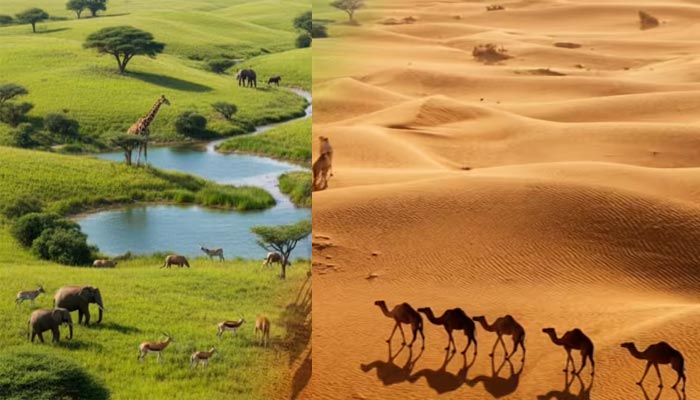
Deserts are often imagined as endless stretches of sand, blazing sun and barren landscapes. But in reality, some deserts around the world look surprisingly green despite receiving very little rainfall.
These regions challenge our usual perception of deserts. Their greenery may come from unique ecosystems, seasonal climate patterns, coastal fog or even human innovation. Yet, scientifically, they still qualify as deserts because they receive extremely low precipitation each year.
This unusual contrast makes them fascinating examples of how nature adapts to harsh environments. In many cases, what looks like a lush landscape is actually a fragile ecosystem surviving in arid conditions.
Green Deserts: Places That Look Lush But Are Still Arid
1. Thar Desert, India
The Thar Desert has undergone a noticeable transformation over the past two decades. Studies suggest its green cover has increased by nearly 38 percent, largely due to stronger monsoon rainfall and the expansion of agriculture.
Despite being one of the most densely populated deserts in the world, parts of the region now feature farmland, vegetation and growing settlements. The greening effect is striking because the Thar still faces water scarcity and remains classified as a dryland ecosystem.
2. Sahel, Africa
Stretching across Africa just south of the Sahara Desert, the Sahel is known for its semi-arid climate and low rainfall. However, satellite observations in recent decades have shown an increase in vegetation in some parts of the region.
Researchers believe rising carbon dioxide levels may be helping plants grow more efficiently even in dry environments. Countries such as Chad and Niger have seen seasonal greening, although the region still faces severe drought risks and fragile soils.
3. Negev Desert, Israel
The Negev Desert receives very little rainfall each year, yet large areas now appear green thanks to advanced irrigation systems.
Israel has pioneered micro-irrigation and water-efficient farming techniques that allow crops, orchards and even vineyards to thrive in this dry environment. From afar, sections of the Negev resemble fertile farmland rather than a desert, even though its climate remains extremely arid.
4. Oregon High Desert, United States
The High Desert region of Oregon receives less than 10 inches of rainfall annually, placing it firmly within the desert category.
However, instead of sand dunes, the landscape is dominated by juniper trees, sagebrush and rugged terrain. Winter snowfall and hardy vegetation often give the area a green and forested appearance, masking the fact that it is technically a desert.
5. Atacama Desert Fog Oases, Chile and Peru
The Atacama Desert is widely considered one of the driest places on Earth. Yet along its coastal hills, patches of vegetation appear in areas known as fog oases or lomas.
These green zones exist because dense Pacific fog drifts inland and condenses on plants, providing moisture without rainfall. Scientists describe them as isolated “islands” of life within the desert, and some only bloom during rare fog cycles that occur once every several years.
Comments are closed.