
Shubhanshu Shukla Blasts Off to Space, Becomes Second Indian in Orbit After 41 Years

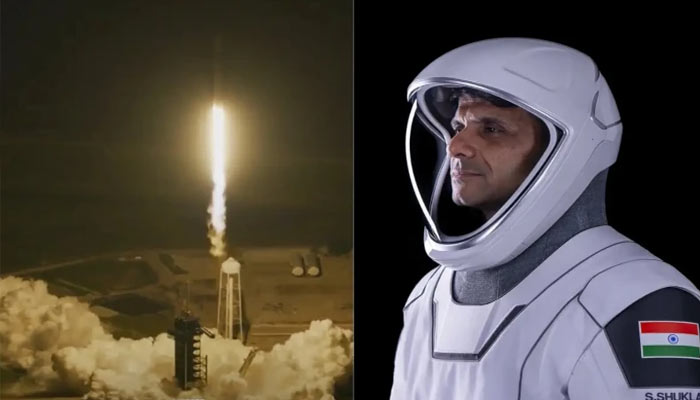
Shubhanshu Shukla Soars Into History: First Indian to Reach Space in 41 Years, Heads to ISS.
The year was 1984. On a frozen Kazakh morning, a young Indian Air Force officer named Rakesh Sharma braced himself inside a Soviet spacecraft. As the Soyuz T-11 engines ignited beneath him, he rocketed through Earth’s atmosphere — and into history — becoming the first Indian to travel to space.
Now, four decades later, that legacy gains a powerful new chapter.
Group Captain Shubhanshu Shukla, a decorated Indian Air Force test pilot, has become the second Indian to enter space — and the first to embark on a mission to the International Space Station (ISS). Launching aboard a SpaceX Dragon capsule as part of Axiom Space’s Ax-4 mission, Shukla’s flight marks a major milestone in India’s growing role in human spaceflight.
Born in 1985 — a year after Sharma’s landmark mission — Shukla quite literally grew up under his shadow, gazing at the stars with dreams of joining them. On Wednesday, those dreams took flight from NASA’s Kennedy Space Center in Florida, as the Falcon 9 rocket thundered into the sky, carrying Shukla and three international crewmates on a 14-day mission in orbit.
A FLAWLESS LIFTOFF
Shukla’s ride into space was nothing short of picture-perfect. As the Falcon 9’s Merlin engines ignited, the rocket surged skyward, delivering the Dragon capsule into Low Earth Orbit with clockwork precision. The first stage returned for a pinpoint landing — a testament to the reusable revolution reshaping space travel.
Suited up an hour before launch, the crew walked out with solemn pride, pausing briefly to wave to loved ones. Among them stood Shukla’s wife and children, eyes brimming with emotion as they watched him step beyond Earth’s bounds.
A JOURNEY DELAYED, NOT DENIED
The Ax-4 launch had initially been set for May 29 but was pushed back seven times due to technical issues, unfavorable weather, and coordination challenges involving SpaceX, Axiom, NASA, and ISRO. During the delays, mission-specific biological payloads were replenished and crew members remained in extended quarantine.
“Setbacks are a normal part of spaceflight,” said Mission Commander Peggy Whitson, the most experienced American astronaut with 675 days in space. “Our Ax-4 crew remained focused and ready.”
MEET THE CREW: A GLOBAL TEAM
Joining Shukla are three spacefarers from across the globe:
Dr. Peggy Whitson (USA), commander of the mission, is a legendary astronaut whose calm leadership and scientific expertise bring gravitas to Ax-4.
Sawosz Uznanski (Poland), a physicist and engineer representing the European Space Agency, focuses on microgravity experiments tied to CERN-level research.
Tibor Kapu (Hungary), a specialist in radiation shielding and polymers, flies under Hungary’s HUNOR space program banner.
Shukla, affectionately known as “Shux” by his crewmates, serves as mission pilot. While Dragon flies autonomously, his role is to monitor trajectory, oversee systems, and serve as the manual backup should intervention be required — a perfect task for a pilot with experience flying MiG-21s, MiG-29s, AN-32s, and Sukhoi-30 MKIs.
A SCIENCE-FILLED STAY AT THE ISS
Once aboard the ISS, Shukla will conduct seven India-designed experiments in collaboration with ISRO and leading Indian research institutions. These include:
- Growing Indian superfoods like moong and methi in zero gravity.
- Studying microbial behavior, muscle loss, and screen-time impacts on mental health in space.
- Investigating human cell aging in microgravity.
- Testing edible algae cultivation as a potential space food.
He will also engage with Indian schoolchildren live from space, sharing insights and inspiring future generations of scientists and explorers.
WHY AX-4 MATTERS TO INDIA
The Ax-4 mission is more than a personal triumph for Shukla — it’s a strategic leap for India. With the indigenous Gaganyaan human spaceflight program on the horizon, Shukla’s real-time exposure to spaceflight operations, ISS protocols, and global collaboration offers critical experience for ISRO and future astronauts.
Shukla is one of the four astronauts shortlisted for Gaganyaan, and his training, participation, and in-orbit performance will directly inform India’s preparations for sending its own astronauts from Indian soil.
From medical protocols and docking rehearsals to inter-agency workflows, his mission offers India a front-row seat to the complex realities of modern space travel — a vital step toward building a robust human spaceflight ecosystem.
A NATION WATCHES
As Dragon arcs toward the ISS, trailing flame and dreams, the streets of Lucknow, Shukla’s hometown, are abuzz with pride. Schools, colleges, and local organizations held live viewings of the launch, celebrating the man now orbiting 400 kilometers above Earth.
In that moment, 1.4 billion Indians saw more than a launch — they saw possibility.
Shubhanshu Shukla isn’t just flying to the ISS. He’s carrying a nation’s hopes, signaling that India is not merely a participant in space — but a partner, a pioneer, and soon, a provider.
As his spacecraft docks with the ISS, the message is clear:
India is ready for the stars — again.
Comments are closed.