

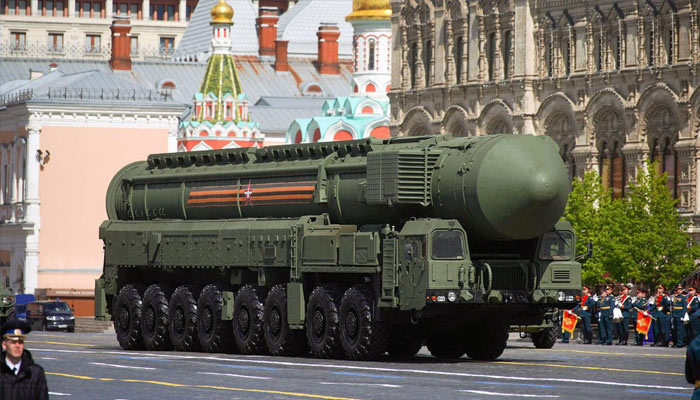
RS-28 Sarmat: Russia’s ‘Satan 2’ Missile and the Return of the Long-Range Nuclear Arms Race.
As geopolitical tensions rise between Russia and the United States, attention has once again turned to one of the most formidable weapons in Russia’s strategic arsenal—the RS-28 Sarmat intercontinental ballistic missile (ICBM), dubbed “Satan 2” by NATO. Designed as a cornerstone of President Vladimir Putin’s nuclear deterrent strategy, the missile is seen as Russia’s answer to the United States’ and China’s evolving missile capabilities.
A Show of Strength Amid Rising Tensions
The renewed focus on the RS-28 follows recent reports of U.S. nuclear submarines operating near Russian waters, a move that has prompted Moscow to flex its strategic muscle. Russian officials have promoted the Sarmat as a missile capable of bypassing Western missile defence systems, with range and payload capacities that significantly outstrip American and Chinese counterparts.
What Makes the RS-28 Sarmat Stand Out?
Developed by the Makeyev Rocket Design Bureau, the RS-28 is a super-heavy, liquid-fueled ICBM intended to replace the Soviet-era R-36M (SS-18 Satan). After years in development, it underwent its first successful test in April 2022.
Key specifications:
Range: Up to 18,000 km, enabling it to strike any target on the globe, including routes over the North and South Poles.
Weight & Size: Weighing approximately 208 tonnes and measuring 35 metres long.
Payload: Capable of carrying 10–15 nuclear warheads using a MIRV (Multiple Independently Targetable Reentry Vehicle) system. Some versions are reportedly armed with Avangard hypersonic glide vehicles, designed to maneuver at high speeds during reentry to evade detection and interception.
The missile’s top speed exceeds Mach 20, placing it firmly in the hypersonic category and making traditional radar and missile defence systems largely ineffective against it.
Strategic Implications
With its enormous range and multiple warhead capability, the Sarmat poses a direct challenge to the U.S. Minuteman III (range ~13,000 km) and China’s DF-41 (range ~12,000–15,000 km), outperforming both in terms of payload and strike flexibility. Analysts suggest it also signals potential threat vectors toward countries such as Ukraine, Japan, and Australia.
Russia frames the missile’s deployment as a deterrence tool, yet many experts see it as a signal of a renewed nuclear arms race—especially in an era where strategic balance hinges as much on deterrence postures as it does on technology.
Strengths and Limitations
Strengths:
- Global reach with over-the-pole strike capability
- Can carry advanced hypersonic and nuclear warheads
- Difficult to intercept due to high speed and irregular flight paths
Limitations:
Uses liquid fuel, requiring more launch preparation time than solid-fueled missiles
Past technical issues, including a reported explosion during a 2024 test, have raised reliability concerns
Emerging U.S. space-based surveillance and interception technologies (e.g. SBIRS) could reduce its strategic surprise
Comments are closed.