
Pakistan’s Indus Delta Shrinks: Water Loss Displaces Over a Million

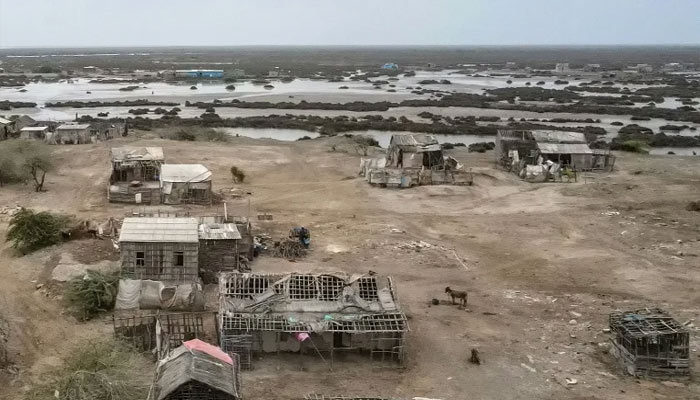
Indus Delta Disappears: Lives, Land, and Livelihoods Lost to Rising Seas and Vanishing River.
Cracked salt crusts crunch beneath Habibullah Khatti’s feet as he walks through the near-abandoned village of Abdullah Mirbahar to bid farewell at his mother’s grave—his final act before leaving his sinking homeland behind.
Once thriving with farms and fishing boats, Pakistan’s Indus delta is now a wasteland of salt, silence, and memories. In Kharo Chan town, where the delta meets the Arabian Sea, decades of seawater intrusion have erased livelihoods and forced a mass exodus.
“The saline water has surrounded us from all four sides,” said Khatti, 54, a former fisherman turned tailor. With fish stocks gone and only four of the original 150 families left in his village, he is preparing to move to Karachi—joining thousands of others displaced by environmental collapse.
A Delta in Retreat
The Indus delta, where one of Asia’s great rivers once emptied its fertile sediment into the sea, is vanishing. According to the Pakistan Fisherfolk Forum, entire communities in coastal Sindh have already disappeared. A study by the Jinnah Institute estimates that over 1.2 million people have been displaced from the broader delta region in the past two decades.
The delta’s demise is driven by a dramatic decline in freshwater flow—down 80% since the 1950s, as canals, dams, and climate change shrink the once-mighty Indus. A 2018 study by the US-Pakistan Center for Advanced Studies in Water linked these reductions to severe seawater intrusion, which has rendered once-fertile land barren and devastated marine life.
Salinity levels in the delta’s water have risen by 70% since 1990, destroying crops and depleting shrimp and crab populations that once sustained local economies.
“The delta is both sinking and shrinking,” said Muhammad Ali Anjum, a conservationist with WWF Pakistan.
A Crisis of Culture and Climate
From the Tibetan Plateau to the Arabian Sea, the Indus River supports more than 80% of Pakistan’s farmland. But today, 16% of delta farmland is no longer usable, according to a 2019 government study.
Villages like Keti Bandar now depend on boats to bring in drinking water from miles away. A white crust of salt coats the ground. Homes are collapsing into the rising tide. “Who leaves their homeland willingly?” asked Haji Karam Jat, who has rebuilt his house farther inland after losing his original home to the sea.
For many, leaving the delta is not just about losing land—but identity. Generations of women who stitched nets and salted fish now find themselves in unfamiliar cities, struggling to adapt. “We haven’t just lost our land, we’ve lost our culture,” said Fatima Majeed, a climate activist whose family fled Kharo Chan for the outskirts of Karachi.
Resistance and Restoration
The delta’s degradation is not accidental. British colonial-era irrigation altered the river’s course, and in recent decades, hydropower projects and canal diversions have worsened the flow crisis. Earlier this year, farmer protests forced a halt to new military-backed canal projects in Sindh.
In response, Pakistan launched the ‘Living Indus Initiative’ in 2021 with UN support to restore parts of the basin. The Sindh government has also initiated mangrove replantation—an effort to rebuild natural barriers against saltwater. But while mangroves grow in some parts, land grabbing and real estate development erase progress elsewhere.
Meanwhile, the looming threat of water scarcity has taken on a geopolitical edge. India recently revoked the 1960 Indus Waters Treaty, a pact that had for decades governed water sharing between the two nations. Pakistan has called India’s actions “an act of war”, fearing upstream dams could further starve the delta of water.
A Vanishing World
What remains of the delta is a fading memory—of bustling harbours, green paddy fields, and woven fishing nets hung to dry. Now, families scatter, pushed into urban margins with little to carry but their stories.
As Khatti prepares to leave his ancestral village, the silence around him speaks louder than the waves. “In the evening, an eerie silence takes over,” he says. “A person only leaves their motherland when they have no other choice.”
Comments are closed.