
Mrs Deshpande review: Madhuri Dixit shines in Nagesh Kukunoor’s layered crime thriller

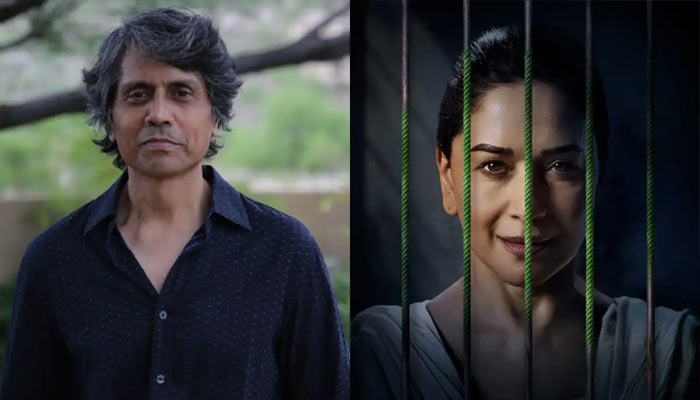
Madhuri Dixit has always carried a concentrated intensity that feels almost regal, as if certain characters arrive already crowned within her.
Across decades and vastly different cinematic worlds, she has demonstrated a rare elasticity of presence—the ability to inhabit a role so fully that it feels less like performance and more like revelation. Whether as Pallavi Patel in Maja Ma, a closeted housewife inching towards self-acceptance, Bahaar Begum in Kalank, a courtesan draped in grace and quiet sorrow, or the quintessentially sanskari Nisha Choudhury in Hum Aapke Hai Koun, Dixit has repeatedly raised the emotional temperature of scenes simply by entering them.
With Mrs Deshpande, Nagesh Kukunoor’s Indian adaptation of the French mini-series La Mante, she delivers yet another commanding turn in a clever, if imperfect, crime thriller that peels itself open layer by layer. The deeper it goes, the more it draws you in—less a passive watch than a slow, unsettling descent.
The premise arrives with the chill of a news headline. A string of murders begins to mirror, with eerie precision, the modus operandi of killings committed 25 years earlier by an imprisoned serial killer. With coincidence ruled out, the police relocate the original murderer, Mrs Deshpande, to a safehouse to help catch the copycat. Dixit plays Mrs Deshpande with unnerving restraint. She agrees to cooperate, but on one condition: she will work only with Inspector Tejas Phadke (Siddharth Chandekar), unaware that he is her son. The hook is blunt and unsettling, transforming a procedural into something deeply personal.
The series wastes little time establishing its tone. A murder unfolds within minutes—swift, clinical, and visually arresting. An actor is strangled with a neon-green rope; his eyes are glued shut, a trophy placed in his hands. When senior IPS officer Arun Khatri (Priyanshu Chatterjee) arrives at the scene, recognition sets in. He has seen this choreography before. He investigated these murders decades ago. He caught the killer. It was Mrs Deshpande.
Yet Mrs Deshpande has been incarcerated in a Hyderabad prison, living under the name Zeenat. Khatri immediately understands this is imitation—a copycat borrowing not just method, but mythology. Inside the prison, Mrs Deshpande is shown working in the kitchen, a disturbingly domestic detail that complicates the idea of monstrosity. When Khatri seeks her help, she agrees—again, strictly on her own terms.
Running parallel is Tejas Phadke, a cop accustomed to the adrenaline of undercover work, abruptly pulled into a case stitched together from old files and unresolved sins. Outside the job, the show gives him softness: a loving marriage to Tanvi (Diksha Juneja), her salon life with friend Divya (Nimisha Nair), and a warm bond with his grandfather Dinanath Phadke (Pradeep Welankar), whom he calls Ajoba. These details matter, grounding Tejas just as the narrative begins to corrode his understanding of family itself.
When Tejas first reads Mrs Deshpande’s file, his view of her hardens into something absolute. To him, she is only what the records say—a serial killer, full stop. That rigidity fuels the tension between them and becomes the series’ engine. From there, the show begins to loosen certainty. Was Mrs Deshpande truly the ruthless monster she is believed to be? Who is the copycat? And how will the truth reshape everyone caught in its orbit?
Kukunoor resists rushing answers. Across six episodes, Mrs Deshpande asks the viewer to sit with discomfort, to move deeper into its corridors of doubt. The pacing is deliberate but gripping, sustained by atmosphere rather than noise. After City of Dreams and The Hunt: The Rajiv Gandhi Assassination Case, Kukunoor once again proves his fluency with OTT storytelling, crafting a narrative that feels taut rather than padded.
The series is mounted with confidence. The cinematography lends the procedural a clean, cold clarity, while the background score integrates seamlessly, tightening tension without drawing attention to itself. Tapas Relia’s opening theme is particularly striking, settling over the show like an omen.
One of the show’s strengths lies in how comfortably it absorbs Indian social realities into its framework. Themes of sexual abuse, trauma, sexuality, identity, and motherhood emerge organically through character histories rather than as explicit commentary. Even without familiarity with the French original, the adaptation feels assured and culturally rooted.
That said, the series is not immune to genre familiarity. A few moments slip into recognisable crime-thriller patterns, and they stand out precisely because the show is otherwise so measured. Still, even when it falters, it remains engaging—a significant achievement in an overcrowded genre.
At its centre is Dixit, the show’s gravitational force. She plays Mrs Deshpande with an ease that is quietly unsettling, balancing concealment and revelation with remarkable control. The character’s moral ambiguity is the show’s lifeblood, and Dixit understands exactly how to sustain it.
Chandekar complements her well, capturing Tejas’ gradual unravelling with restraint. Chatterjee brings calm authority as Khatri, while Juneja adds warmth as Tanvi, grounding the emotional stakes. Nimisha Nair impresses with a performance that evolves convincingly, and Kavin Dave stands out in a role that allows him greater complexity than usual. The supporting cast, including Vishwas Kini and Sulakshana Joglekar, strengthens the ensemble with controlled, credible performances.
By the time Mrs Deshpande concludes, it leaves you in a moral fog. The answers arrive, but certainty does not. It is a thriller that understands the value of residue over resolution. Gripping as a crime story, quietly haunting as a psychological study, and anchored by Madhuri Dixit’s formidable presence, the series reaffirms why she continues to occupy a league of her own.
Comments are closed.