
The modern Buddhist Circuit: Linking Uttar Pradesh’s sacred plains with Japan’s temples

As the world undergoes rapid geopolitical realignments and the United States continues to recalibrate its alliances, modern diplomacy is increasingly shaped by trade equations and military partnerships.
Yet, the emerging relationship between Uttar Pradesh and Japan’s Yamanashi Prefecture charts a markedly different course—one rooted not in hard power, but in a shared spiritual inheritance that transcends borders and centuries.
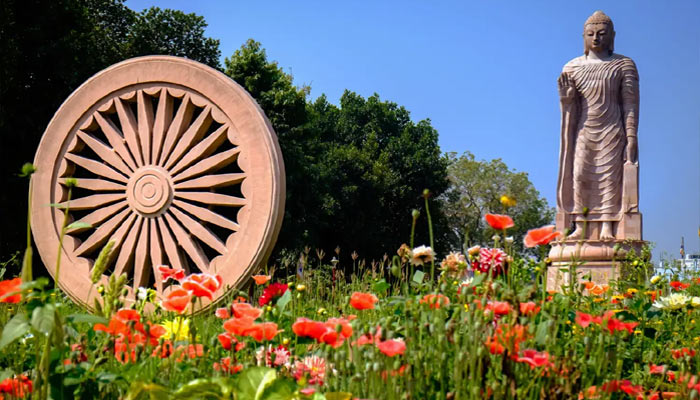
At the heart of this partnership lies the Buddhist Circuit, a constellation of sacred sites stretching from the fertile plains of Uttar Pradesh to the ancient temples of Japan. More than a diplomatic initiative or a tourism project, the circuit represents a civilisational bridge—one that has shaped Asian thought, culture, and philosophy for over two millennia.
The foundations of Buddhism were laid in this region. Sarnath, where Lord Buddha delivered his first sermon, marks the birth of Buddhist philosophy. Kushinagar, where he attained Mahaparinirvana, symbolises the culmination of his earthly journey. Nearby Bodh Gaya in Bihar—connected historically through ancient monastic routes—remains inseparable from Uttar Pradesh’s spiritual ecosystem. Together, these sites form the core of a living heritage that continues to resonate across Asia.
For Japan, where Buddhist traditions have flourished for more than 1,400 years, these locations are not distant historical landmarks but the very source of a cultural and spiritual lineage that continues to shape contemporary society. Japanese visitors do not arrive in India merely as tourists; they come as pilgrims, seeking a deeper connection with the origins of their faith and identity. This shared devotion fosters a powerful form of people-to-people diplomacy—one that no formal summit or state visit can replicate.
The economic implications of this spiritual exchange are equally significant. Unlike conventional tourism, which is often seasonal, pilgrimage-driven travel sustains year-round demand. Uttar Pradesh has already witnessed this effect in Ayodhya following the Ram Mandir pran pratishtha. Buddhist tourism carries similar transformative potential.
Japanese tourists, in particular, are known for longer stays and higher spending, delivering outsized benefits to local economies. The development of infrastructure around Buddhist sites—hotels, transport, cultural centres, and local enterprises—creates sustained employment while preserving heritage. If fully realised, Buddhist tourism from Japan alone could attract millions of visitors annually, reshaping the economic landscape of eastern Uttar Pradesh.
Japan also brings invaluable expertise in heritage conservation. Its approach—blending meticulous preservation of tradition with advanced technology—offers lessons for reimagining how India protects and presents its ancient sites. Investments in interpretive museums, digital reconstructions, and sustainable tourism infrastructure could set new global benchmarks for heritage management.
The proposed Centres of Excellence at Banaras Hindu University and other institutions will further institutionalise this collaboration. Focused on Buddhist studies, conservation, and cultural exchange, these centres can generate cutting-edge research while nurturing a new generation of scholars and practitioners who will carry this partnership forward.
In essence, the Uttar Pradesh–Yamanashi partnership offers a replicable model for cultural diplomacy—one that other Indian states could adapt by leveraging their own historical and spiritual linkages with countries across Asia.
In a world increasingly fractured by politics and ideology, the Buddhist Circuit serves as a quiet yet powerful reminder of shared humanity and the universal pursuit of wisdom and enlightenment. By investing in this sacred heritage, Uttar Pradesh—under Chief Minister Yogi Adityanath—and Japan are not merely preserving the past; they are laying the groundwork for a more connected, empathetic, and culturally anchored future.
Comments are closed.