

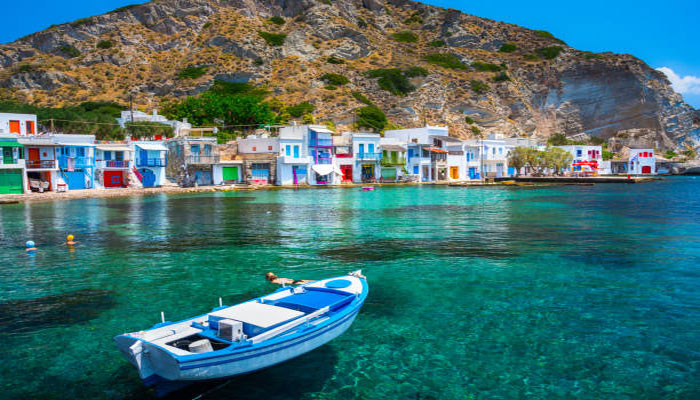
A major hotel expansion on the Aegean island of Milos has become a flashpoint in a growing battle over mass development in Greece’s island hotspots.
On a sloping stretch of Milos’s volcanic coastline, heavy machinery surrounds the foundations of a planned 59-room extension to a luxury resort, complete with private pools. The project sparked fierce backlash last year, prompting Greece’s top administrative court to temporarily suspend its building permit.
Milos Mayor Manolis Mikelis has described the construction as an “environmental crime,” arguing that the island’s globally recognised geological landscape is at risk. Milos is famed for its dramatic rock formations and as the discovery site of the ancient statue known as the Venus de Milo.
The dispute reflects a wider development surge sweeping across the Cyclades, where booming tourism has fuelled intense real estate activity. Traditional scenes of whitewashed houses and blue-domed churches are increasingly sharing space with large-scale construction projects.
In December, mayors from the Cyclades and the neighbouring Dodecanese — including major tourist destinations such as Rhodes and Kos — issued a joint warning that unchecked building threatens the very character and sustainability of their islands.
On Santorini, which hosts millions of visitors annually despite a relatively small resident population, local officials have raised concerns that tourism growth is being driven increasingly by luxury housing developments rather than balanced planning. Santorini’s mayor has been among those urging tighter controls on large-scale projects.
Developers, however, argue that expansions are proceeding with the necessary approvals. V Tourism, which operates the Milos resort, has said its project received favourable opinions from all relevant authorities. Critics counter that gaps in planning legislation and fast-track procedures for so-called “strategic investments” have enabled excessive construction with limited oversight.
Environmental concerns are particularly acute at Sarakiniko, Milos’s iconic white-rock beach shaped by erosion and often dubbed “moonlike” for its otherworldly appearance. Despite its popularity and unique geology, the site does not currently enjoy formal legal protection. A separate hotel project there was halted last year, with authorities ordering remediation work at the excavation site.
Academics and local officials warn that speculative buying has transformed once-marginal grazing land into high-value property. Investors purchase plots at relatively low prices, build or resell at significantly higher valuations, and reshape entire coastal areas in the process.
Tourism remains central to Greece’s economy, accounting for a substantial share of national output and drawing record numbers of visitors in recent years. In Milos alone, dozens of new hotel projects are underway, while hundreds of building permits have been issued across islands such as Paros and Santorini.
Yet the rapid expansion has also brought mounting pressures: rising housing costs for residents, strain on water supplies and waste systems, and concerns that architectural standards are drifting away from traditional Cycladic styles.
There are tentative signs that growth may be stabilising in some areas. Santorini recorded a notable dip in summer air arrivals last year, while nearby Mykonos saw only modest gains.
For many islanders, the debate boils down to a difficult balance between economic opportunity and preserving the landscapes that made the Cyclades world-famous in the first place.
Comments are closed.