
Rising Seas, Rising Conflict: Climate Change Deepens Crisis for Sundarbans’ ‘Tiger Widows’

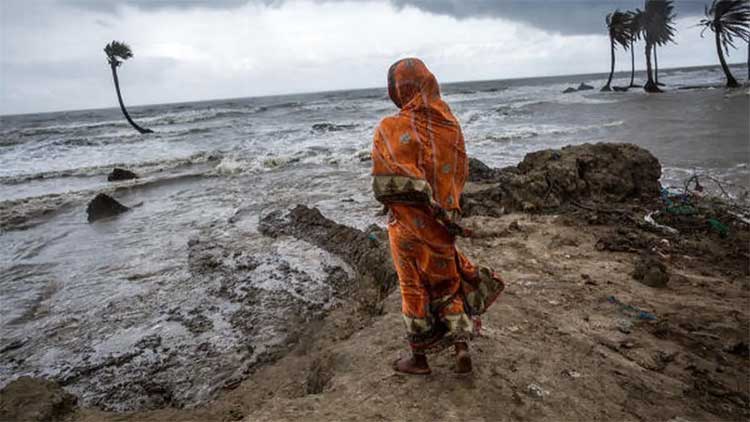
In the vulnerable Sundarbans delta, climate change is deepening the hardships faced by so-called “tiger widows” — women whose husbands were killed by Royal Bengal tiger — as environmental degradation and economic stress drive more families into risky forest-dependent livelihoods.
In Chargheri village on Satjalia island, Rina Sarkar carefully navigates muddy, waterlogged terrain as she joins dozens of other women planting mangrove saplings along a fragile embankment. She is among many in the region who bear the label “tiger widow,” a term used locally for women whose spouses fell victim to tiger attacks.
“In 2022, my husband went to catch fish and crabs and never returned,” Sarkar recalls quietly. “He was killed by a tiger.”
Across the Sundarbans, thousands of such women live with economic insecurity, psychological trauma, and persistent social stigma. Community workers say these challenges are intensifying as climate pressures reshape both the landscape and local livelihoods.
Social exclusion and compensation gaps
For many widows, the loss of a husband often triggers not only financial instability but also ostracisation. Some face deeply rooted cultural prejudices, including derogatory labels that portray them as bearers of misfortune.
Advocates note that families frequently struggle to access compensation schemes meant for wildlife-related deaths. A key barrier arises when victims had entered protected forests without official permits — a common practice in a region where fishing and crab collection remain among the few viable income sources.
Without formal recognition of such incidents, surviving families may be excluded from government relief, leaving widows vulnerable to poverty and exploitation.
Climate change and rising conflict
The Sundarbans, the world’s largest mangrove ecosystem, is increasingly affected by rising sea levels, stronger cyclones, and salinity intrusion. These shifts are steadily altering habitats and livelihoods.
As land erodes and islands become submerged, tiger territories shrink or shift, sometimes bringing the animals closer to human settlements. At the same time, declining fish stocks and degraded soil conditions are pushing more residents to venture deeper into forests in search of income.
Researchers and local organisations warn that this combination — habitat loss for wildlife and mounting economic stress for communities — is contributing to heightened human-tiger conflict.
Mangrove restoration efforts
In response to escalating climate threats, grassroots groups such as the Purbasha Eco Helpline Society have focused on mangrove restoration and community support. Mangroves serve as natural barriers against cyclones and tidal surges while helping stabilise coastlines.
Since its founding, the organisation has led large-scale planting drives across several islands, supported by local volunteers. It also promotes alternative livelihoods aimed at reducing dependence on hazardous forest activities.
Yet for many tiger widows, daily survival remains uncertain.
“Planting mangroves helps protect our villages,” Sarkar says. “But after my husband’s death, it has been very hard to support my children.”
The experience of these women underscores a broader reality in the Sundarbans, where climate change, fragile ecosystems, and economic vulnerability are increasingly intertwined.
Comments are closed.