
One Year On, Air Marshal Bharti and Col. Qureshi Remain Defining Faces of Op Sindoor

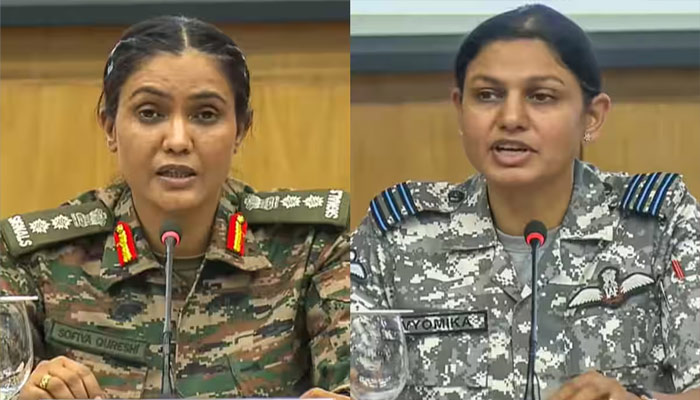
One year after Operation Sindoor, the faces that came to define India’s retaliatory military.
Action against terror infrastructure in Pakistan and Pakistan-occupied Kashmir continue to leave a lasting impression on the public imagination.
Launched in response to the April 22 Pahalgam terror attack, Operation Sindoor saw the Indian armed forces carry out coordinated strikes on terror camps across the border. While the operation itself was led by personnel across the Army, Navy and Air Force, a handful of senior officers emerged as the public voices of the mission through a series of high-profile press briefings.
Among the most recognisable figures were Sofiya Qureshi, Vyomika Singh and Prerna Deosthalee — three women officers who regularly briefed the media on the progress of the operation and became symbolic faces of the armed forces’ response.
Colonel Sofiya Qureshi, known for her calm and precise communication style, had already made history in 2016 as the first woman officer to lead an Indian Army contingent at a multinational military exercise involving ASEAN-Plus nations. Hailing from Gujarat’s Vadodara and commissioned through the Officers Training Academy in Chennai, she earned widespread praise during the Operation Sindoor briefings for her composed demeanour under pressure.
Wing Commander Vyomika Singh, a helicopter pilot commissioned into the Indian Air Force in 2004, also emerged as a prominent public face during the operation. With over 2,500 flying hours in challenging terrains, Singh repeatedly underscored India’s readiness to respond to any escalation from Pakistan and became known for her firm messaging during media interactions.
Commander Prerna Deosthalee, who joined the Navy in 2009 and later became the first woman officer to command an Indian naval warship, represented the naval side of the operation during the briefings. A postgraduate in psychology from Mumbai’s St. Xavier’s College, she had been appointed Commanding Officer of INS Trinkat in 2023.
The operation’s daily media briefings were also led by senior military officials including Rajiv Ghai, AK Bharti and AN Pramod, whose sharp responses and direct communication style resonated strongly during the tense standoff.
One of the defining moments came when Air Marshal AK Bharti, responding to questions about casualties across the border, remarked: “Our job is to hit the target, not count the body bags.” The statement quickly became one of the most quoted lines associated with Operation Sindoor.
Bharti also drew attention for his response to speculation over alleged strikes on Pakistan’s Kirana Hills nuclear-linked facilities. Dismissing the claims with sarcasm, he remarked that India neither knew of nor targeted any such installation.
Lieutenant General Rajiv Ghai, who served as Director General of Military Operations during the conflict, later went on to become Deputy Chief of Army Staff (Strategy). Vice Admiral AN Pramod, meanwhile, continued to represent the Navy’s operational perspective and recently said the operation had effectively exposed what he described as Pakistan’s “nuclear blackmail.”
Marking one year of Operation Sindoor on Thursday, the three senior officers once again addressed the media, reiterating that the military action was not an isolated event but part of a broader strategic message against terrorism.
“Operation Sindoor was not an end. It was just the beginning,” Lt Gen Rajiv Ghai said during the anniversary briefing.
Air Marshal AK Bharti said the operation reaffirmed the importance of air power in modern warfare, while Vice Admiral AN Pramod stated that India’s use of long-range precision strikes demonstrated its ability to hit terror infrastructure deep inside Pakistan despite nuclear rhetoric from across the border.
Comments are closed.