
Congress Ends 59-Year Drought in Tamil Nadu With 5 Rajya Sabha Seats, 2 Minister Berths

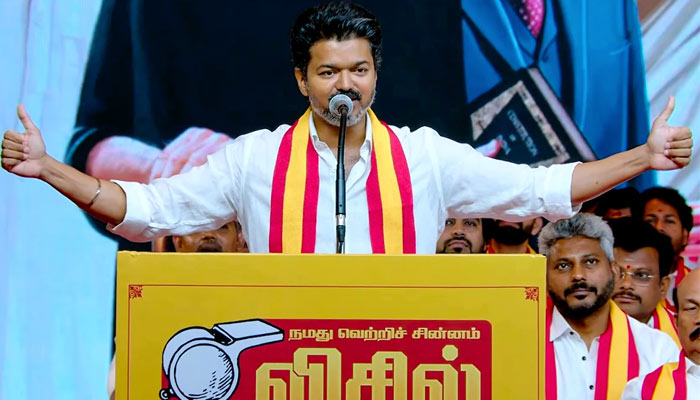
Nearly six decades after the Congress last held power in Tamil Nadu’s government, the party has staged an unlikely return — not through electoral dominance, but through strategic relevance in a fractured mandate.
The last time Congress ministers sat in the Tamil Nadu cabinet was in 1967, when Zakir Hussain had just become India’s first Muslim President, the Vietnam War dominated global headlines, and Cold War tensions between the United States and the Soviet Union were escalating once again. That year also marked a political turning point in Tamil Nadu, as the Congress lost its grip on the state and the Dravidian era began.
For the next 59 years, Tamil Nadu politics remained firmly controlled by the two Dravidian giants — the DMK and the AIADMK — leaving the Congress increasingly marginalised in Assembly politics.
That changed this week.
Congress leaders Rajesh Kumar and P Vishwanathan were sworn in as ministers in Chief Minister Joseph Vijay’s Tamilaga Vettri Kazhagam (TVK) government, ending the party’s decades-long absence from power in the state.
The development follows Tamil Nadu’s dramatic 2026 Assembly election, where actor-turned-politician Vijay emerged as the surprise challenger to the entrenched Dravidian order. Riding a massive wave of popular support, the TVK won 108 of the state’s 234 seats, while both the DMK and AIADMK suffered major setbacks.
But despite the breakthrough performance, Vijay fell short of the majority mark of 118 seats. The Congress, which won only five seats, suddenly found itself in a kingmaker’s role.
Those five MLAs became crucial to the formation of the government.
Though numerically small, the Congress’ support significantly reduced the TVK’s gap to power and triggered a broader realignment among smaller parties and independents. In effect, the Congress converted a poor electoral showing into substantial political leverage.
The outcome also reflected growing friction between the Congress and the DMK before the polls. Seat-sharing negotiations had reportedly become tense, with the Congress demanding a larger share of seats and a commitment to cabinet representation if the alliance returned to power. The DMK refused both demands, insisting that ministerial berths for allies would weaken governance efficiency.
Even before the election, there had been speculation about a possible Congress-TVK understanding, especially as Vijay’s popularity surged across the state. Although the Congress eventually remained with the DMK-led alliance, sections within the party reportedly believed aligning with Vijay could offer better long-term political dividends.
The election results appeared to validate that assessment.
Sensing the changed political landscape, the Congress quickly shifted strategy after the verdict and extended support to the TVK government. The party’s primary condition was that no “communal forces” be included in the alliance — an indirect reference to the BJP, which had tied up with the AIADMK. Since Vijay had already positioned the BJP as an ideological rival, the agreement came together smoothly.
The move angered the DMK, which accused the Congress of betrayal, but by then the numbers had tilted decisively toward Vijay. Support from additional smaller parties eventually helped the TVK cross the majority mark.
For the Congress, the significance of this moment goes beyond the two cabinet berths it secured.
The party has demonstrated that even limited numbers can translate into influence in a fractured political landscape. After decades of decline in Tamil Nadu, the Congress has found a route back into relevance — not by reviving its old dominance, but by adapting to a new era of coalition arithmetic and tactical politics.
The development may also shape the party’s strategy in other states where it has struggled to regain ground, particularly ahead of major elections next year, including Uttar Pradesh.
Whether this marks the beginning of a larger Congress revival in Tamil Nadu remains uncertain. But after 59 years in the wilderness, the party has finally found its way back into the room where power is exercised.
Comments are closed.