
First E20 Fuel Protest: Motorists Allege Lower Mileage, Fuel System Problems

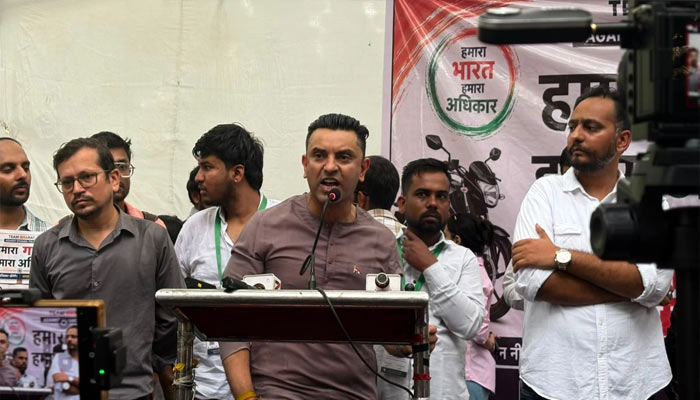
First Protest Against E20 Fuel: Motorists Allege Mileage Drop, Fuel System Damage
Delhi’s Jantar Mantar witnessed the country’s first on-ground protest against the Centre’s E20 fuel mandate on Sunday, with car owners alleging that the higher ethanol blend has led to reduced mileage, fuel system problems and expensive repairs. Organised by Team Bharat under the slogan “Hamaari Gaadi, Hamaara Adhikaar”, the demonstration brought together motorists demanding greater transparency and the option to choose conventional petrol.
The protest was led by entrepreneur and television personality Tehseen Poonawalla, who criticised what he described as the government’s hurried implementation of the Ethanol Blended Petrol (EBP) programme.
While complaints about E20 have circulated on social media for months, Sunday’s gathering marked the first organised public protest over the policy. Participants stressed that the event was non-political, with several claiming they supported the BJP but opposed the way the E20 rollout had been implemented.
Motorists Claim Mileage Loss, Mechanical Issues
Several protesters shared personal accounts of alleged problems after switching to E20 fuel.
Sarthak, a software engineer from Gurugram who owns a 2018 Maruti Baleno, claimed his vehicle’s fuel efficiency had fallen sharply.
“My mileage has dropped from around 18 kmpl to under 14 kmpl over the last few months,” he alleged.
Delhi resident Raj Singh said he spent more than Rs 35,000 repairing his car after noticing engine performance issues.
“I had been filling E20 fuel for about seven months. Then my car suddenly started losing power and the engine warning light came on. I had to get the entire fuel system cleaned and replace parts,” he claimed.
Another protester, Mudit Agarwal, alleged his Skoda Slavia broke down unexpectedly and had to be towed.
“The service centre told me ethanol could be the reason. They said several cars with similar issues were coming in every day,” he claimed, adding that he attended the protest as a concerned vehicle owner.
Experts Defend Government’s E20 Policy
The Centre has consistently rejected allegations that E20 fuel causes excessive wear and tear or significant mileage loss in compatible vehicles.
Ahead of Sunday’s protest, a group of automobile and energy experts defended the ethanol-blending programme, saying extensive testing had found no evidence that E20 damages vehicles designed to use the fuel.
India accelerated its ethanol-blending programme and achieved its E20 rollout target five years ahead of schedule. The government says the policy will reduce crude oil imports, lower carbon emissions and boost farmers’ incomes by creating demand for ethanol produced from sugarcane and other feedstocks.
However, critics argue that a large number of older vehicles on Indian roads were originally designed for E10 fuel and may not be fully compatible with E20.
Demand For Fuel Choice And Greater Transparency
Many protesters said they were not opposed to ethanol blending itself but wanted consumers to have the option of purchasing regular petrol.
Himanshu Sharma, who attended the protest, questioned why motorists were not being offered a choice.
“Why don’t I have the option to choose the fuel? I need pure petrol,” he said.
A doctor from Moradabad, who requested anonymity, also claimed he had noticed a decline in his car’s fuel efficiency despite maintaining it carefully.
“I support reducing oil imports, but not if it comes at the cost of my vehicle,” he said.
Auto enthusiast and rally driver Ratan Dhillon, associated with Team Bharat, alleged that ethanol-blended fuel causes clogging in fuel filters and pipelines. He said the group intended to present technical evidence in court to support its claims.
Concerns Over Policy Rollout
Some protesters also questioned the pace of India’s transition to E20, arguing that countries such as Brazil and the United States introduced higher ethanol blends gradually alongside compatible vehicle technology.
Others linked the policy to the sugar industry’s economic interests, alleging that ordinary motorists were bearing the burden through higher maintenance costs and lower fuel efficiency.
Despite the relatively small turnout, participants said the protest reflected growing concerns among vehicle owners over the impact of E20 fuel. They called for greater transparency, independent testing and the availability of fuel choices, while the government continues to maintain that the ethanol-blending programme is backed by scientific studies and remains an important part of India’s energy strategy.
Comments are closed.