
Cristiano Ronaldo Bows Out After Spain Eliminate Portugal From World Cup

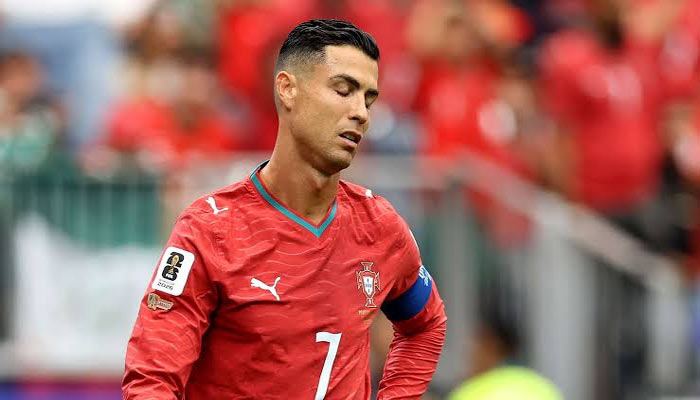
For a few seconds, he simply stared at the scoreboard. Portugal 0, Spain 1.
Around him, Spanish players celebrated reaching the FIFA World Cup quarter-finals. For Ronaldo, the reality slowly sank in — there would be no seventh World Cup, no final shot at lifting the one trophy that had always escaped him.
Only then did the tears come.
Portugal’s World Cup campaign ended in heartbreaking fashion on Monday as Mikel Merino’s stoppage-time winner sealed a 1-0 victory for Spain, bringing the curtain down on what is expected to be Ronaldo’s final appearance on football’s biggest stage.
For more than two decades, Ronaldo carried Portugal through some of the greatest nights in the country’s football history. But there would be no fairytale ending, no last-minute winner, no final act of heroism. The World Cup remained the one honour missing from an extraordinary career.
Watching the 41-year-old walk off the pitch, football’s familiar club rivalries suddenly felt irrelevant. Whether you admired Lionel Messi, supported Barcelona or Real Madrid, or believed Portugal should already have moved beyond Ronaldo, this was simply the end of one of international football’s greatest careers.
The criticism Ronaldo faced throughout this tournament was understandable. Age has inevitably diminished the explosive pace and relentless athleticism that once made him virtually unstoppable. Yet Roberto Martinez continued to trust his captain, and Ronaldo responded with a tireless display.
He dropped into midfield to link play, battled Spain’s defenders, pressed whenever possible and remained Portugal’s primary attacking outlet. It was no longer vintage Ronaldo, but it was a performance defined by determination rather than decline.
Spain’s patience finally paid off
Spain controlled possession for long periods, with Rodri dictating the tempo, Pedri knitting together attacks and Dani Olmo consistently finding pockets of space between Portugal’s defensive lines.
Mikel Oyarzabal squandered an excellent early opportunity, but Portugal’s resistance remained intact thanks largely to Diogo Costa and the centre-back pairing of Ruben Dias and Renato Veiga. Costa produced several crucial saves, while Dias and Veiga repeatedly blocked shots, won duels and disrupted Spain’s intricate attacking combinations.
Nuno Mendes also delivered another outstanding defensive display, largely keeping teenage sensation Lamine Yamal quiet for much of the contest. But when the Paris Saint-Germain full-back limped off late in the game after stretching to stop Yamal, Portugal lost the defender best equipped to contain Spain’s biggest threat.
Ronaldo still showed flashes of the instincts that defined his career. A trademark stepover created space for a shot that forced Unai Simon into a save, while later he arrived agonisingly late to Pedro Neto’s dangerous cross across the six-yard box.
The problem for Portugal was not that Ronaldo looked finished.
It was that too much still depended on him.
As the second half wore on, Ronaldo repeatedly dropped deep searching for possession, only to find Spain already organised behind the ball before Portugal could launch meaningful attacks. Too often he looked up to see few teammates making forward runs.
After more than 90 minutes of disciplined defending, Portugal were finally undone in stoppage time.
A quickly taken free-kick caught Martinez’s side before they had fully reorganised. Fabian Ruiz slipped an incisive pass into Ferran Torres, whose clever first-time lay-off split Portugal’s defence. Merino timed his run perfectly, slipped between Dias and Veiga and calmly guided his finish beyond Costa into the bottom corner.
One lapse was all Spain needed.
The end of an era — and questions for Portugal
The goal visibly shook Ronaldo.
Throughout the second half, his frustration had become increasingly evident. He repeatedly dropped into his own half searching for the ball, trying to influence a game that was slowly slipping away.
At 41, Ronaldo can no longer be expected to carry an entire attack through pace and relentless movement. But his experience still allows him to sense when a match is drifting beyond his team’s control. His constant search for possession reflected a player trying to solve problems that perhaps should never have become his responsibility.
That inevitably raises questions for Roberto Martinez.
Portugal desperately needed fresh attacking legs during the closing stages, yet Goncalo Ramos remained on the bench despite being one of the country’s most natural finishers. Martinez used all five substitutions elsewhere, leaving Ronaldo to complete the full match as Portugal struggled to create clear chances.
The Portuguese coach may now face scrutiny over whether he extracted enough from one of Europe’s most gifted generations.
With Bruno Fernandes, Bernardo Silva, Vitinha, Rafael Leao, Nuno Mendes, Diogo Costa and Goncalo Ramos at his disposal, Portugal possess enormous talent. Yet throughout this World Cup they often looked organised rather than adventurous, reactive rather than authoritative.
When the final whistle blew, Ronaldo stood alone before emotion finally overwhelmed him.
He leaves international football as Portugal’s greatest player — the leading scorer in men’s international football with more than 140 goals, the most-capped men’s international in history with over 220 appearances, the captain who delivered Euro 2016 and two UEFA Nations League titles, and the player who transformed Portuguese football forever.
The World Cup trophy will remain the one prize missing from his glittering collection.
Perhaps it simply was never meant to be.
Yet this tournament also offered Portugal something equally significant.
Nuno Mendes confirmed himself among the world’s elite full-backs. Diogo Costa strengthened his reputation as one of Europe’s finest goalkeepers. Renato Veiga looked ready to inherit the leadership once provided by Pepe. Around them remain Bruno Fernandes, Vitinha, Rafael Leao and Goncalo Ramos — a new generation capable of leading Portugal into the future.
No one will replicate what Cristiano Ronaldo achieved in the famous red shirt.
No one needs to.
He gave Portugal everything he had.
As he walked away from the World Cup in tears, perhaps, for the first time in more than two decades, Cristiano Ronaldo could finally lay down the burden he had carried for so long.
His story is complete.
The World Cup simply wasn’t part of its ending.
Comments are closed.