

The margin was four hundredths of a second. Gulveer Singh had spent the last lap of the 5000m final doing what he does now almost as a matter of habit, holding position in the pack, reading.
The field, waiting. With 200m to go, he was fifth. He was not supposed to be on the podium. Then he was third, edging out Kenya’s Cornelius Kemboi by 0.04 seconds, and Indian athletics had done something it had never managed in the 136-year history of the Commonwealth Games: put the same Indian man on two different track podiums at the same edition.
Four days earlier, Gulveer had gone one better in the 10,000m, running down the field in the closing stages for silver behind Australia’s Ky Robinson. Between the two races sits the story India has been circling for two years now: a farmer’s son from Sirsa in Uttar Pradesh’s Atrauli district, who took up running not because he loved it but because it was the fastest way to pass an Army fitness test, ending up, at 28, as the man who dragged Indian distance running into rooms it had never been allowed into before.
BUILDING THE BASE
“Training in Colorado for the last three years, he has had the opportunity to experience heat, humidity, cold weather and snow. He can compete in any of these environments,” Scott Simmons, the American coach who has overseen Gulveer’s training since he shifted his permanent base to Colorado Springs in 2024, arriving in the United States that March, tells DD News.
It is a small, practical-sounding sentence, but it explains a great deal about how a runner who once trained on dirt roads to clear an Army fitness test now finishes races calmly enough to out-kick Olympic-adjacent fields in the rain.
Simmons is careful not to make the double sound accidental.
“It was his training focus for the entire year. He trained at 100 percent. No injuries and no health issues. Just very disciplined in his training, his diet, his rest and recovery. He was ready to run to the best of his ability and we saw how that measured with some of the best athletes in the Commonwealth Games.”
BEATING REAL FIELDS
That last clause is worth dwelling on, because it cuts against the reflex that greets every Indian Commonwealth Games medal: that the field wasn’t really there, that this is Asian Games-adjacent competition dressed up in a bigger ceremony. Glasgow’s track and field programme did not behave that way.
Gulveer’s 5000m had Kemboi and two more Kenyans in the top twelve, a Ugandan in fifth, runners from Lesotho and Tanzania further back, a field pulled straight from the sport’s deepest well. His 10,000m was worse, in the sense that mattered to him: Kenya had medalled in that event at every Commonwealth Games since 1986 and left Glasgow with nothing, its three runners finishing fourth, and further back after a mid-race mishap cost one of them his shoe. Uganda’s streak in the event ran back to 2006. Both fell in the same fortnight that Gulveer stood on the podium twice. Beat that field and it is no longer plausible to file the result under “decent for the Commonwealth Games.” It is simply a fast field, beaten.
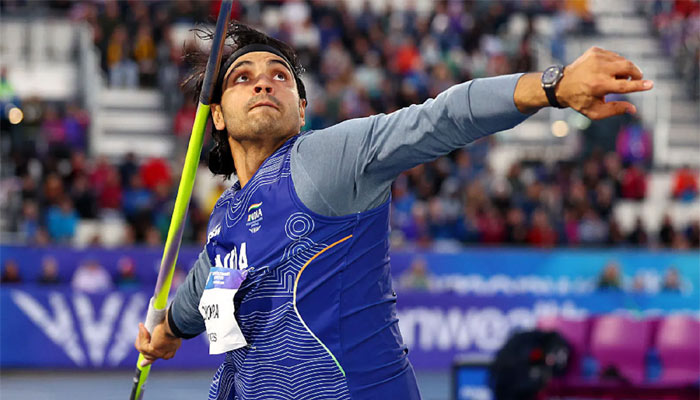
The javelin final made the same point with different names. Neeraj Chopra’s silver came in a field that included Pakistan’s Arshad Nadeem, the reigning Olympic champion, Grenada’s Anderson Peters, a former world champion, and Trinidad’s Keshorn Walcott, the reigning world champion, the world leader and eventual gold medallist Rumesh Pathirage of Sri Lanka, throwers who would not look out of place in a World Championships final, let alone a Commonwealth one.
Nadeem, for context, did not even make the podium, eliminated after three rounds. The decathlon bronze that followed arrived in a field headlined by Grenada’s Lindon Victor, a Paris 2024 Olympic bronze medallist, and Canada’s Damian Warner, the Tokyo Olympic champion. This was not a soft touch. It was, across several disciplines, as close to Olympic density as the Commonwealth Games gets.
“Change in mentality for sure,” Simmons says, when asked what a result like Gulveer’s does for the athletes who come after him.
“When you have an athlete like Gulveer Singh, who won a silver medal, when you had Avinash Sable, who won a medal in steeplechase in the last Commonwealth Games, it gives the others the idea they can do that as well. If they apply themselves, if they have support like Gulveer has now from TOPS (Target Olympic Podium Scheme), the federation and the government is doing that now, taking a chance on the athletes to apply themselves and do their best.”
BEYOND ONE MAN
For a long time, the shorthand for Indian athletics was one name. Neeraj Chopra missed Birmingham through injury and Indian athletics coverage spent four years waiting for him to come back and be the story again. He did come back, come back from an injury, and he did throw well: 85.83m for silver, his first Commonwealth Games medal since Gold Coast 2018, beaten only by Sri Lanka’s Rumesh Pathirage, whose 89.75m gave his country its first athletics gold at the Games.
But Neeraj’s silver landed as the fourth Indian athletics medal of that particular evening’s news cycle, not the first, and it arrived alongside a bronze from Yashvir Singh, a personal best of 85.41m on Commonwealth Games debut that gave India a javelin double podium for the first time in the event’s history.
Yash Vir’s bronze is worth pausing on for what it says about depth rather than a single throw: Indian javelin now has Neeraj at the top, and behind him a queue that already includes Rohit Yadav, Kishore Jena, Sachin Yadav and DP Manu. Neeraj Chopra being merely one good story among several is, by itself, the headline this year.
TEJASWIN SHANKAR’S ESCAPE ACT
No result this Games captured that harder-fought quality better than Tejaswin Shankar’s. He arrived in Glasgow meaning to compete in two events, the high jump and the decathlon, and by the second day of competition the high jump had gone spectacularly wrong. His chronic patellar tendinitis flared on his opening attempt and he pulled out of the final in visible pain, in tears, uncertain whether he would even take the start line for the decathlon less than 48 hours later.
“The bitterness started two days ago,” he said afterwards. “I just took one jump and my knee gave up. I had severe pain.” He credited his support team simply with getting him back on track in time.
What followed was, by any measure, the toughest ask on the entire programme: 10 events across two gruelling days, on a knee that had given out days earlier, against a field that included an Olympic bronze medallist and a reigning Olympic champion. Tejaswin held third through the second day, responding to pressure from Grenada’s Victor and Canada’s Warner with a personal-best-adjacent discus throw and a season-best javelin when it mattered, before closing the meet with 7,976 points and India’s first-ever Commonwealth Games decathlon medal.
It was also the second different individual event in which he has won a Commonwealth Games medal, after his high jump bronze at Birmingham 2022, making him the first Indian track and field athlete to achieve that feat across editions of the Games.
It was a dream-come-true moment for Tejaswin, one built on resilience as much as talent. Given how his week began, though, it felt less like a dream and more like an escape act.
THE NEW ARITHMETIC
It is worth sitting with the numbers this produced, because they say in arithmetic what quotes can only gesture at. At Birmingham 2022, Indian athletics won eight medals. In Glasgow, it won 16, 10 on the track and field, six more from a para-athletics contingent that ended a two-decade wait for a Commonwealth Games podium.
That is not incremental improvement. That is a discipline doubling its return in one Games cycle, against fields that were, if anything, harder to crack than four years ago.
10 ON THE BOARD
Gulveer Singh (Men’s 10,000m, Silver) — 27:49.78s, India’s first-ever Commonwealth Games medal in the event, run down in the closing stages behind Australia’s Ky Robinson as Kenya’s 40-year streak on the podium ended behind them.
Gulveer Singh (Men’s 5000m, Bronze) — 13:24.95s, four days later, holding off Kenya’s Cornelius Kemboi by 0.04 seconds to become the first Indian track and field athlete to win two individual medals at a single Commonwealth Games.
Sarvesh Kushare (Men’s High Jump, Silver) — Cleared 2.25m to become the first Indian to win a Commonwealth Games medal in the men’s high jump in the event’s 136-year history. Born to a farming family in Maharashtra, he trained for years on a makeshift pit of corn husks and agricultural waste that his father built him; this year he broke Tejaswin Shankar’s eight-year-old national record and finished third at a Diamond League meeting in Monaco, only the fourth Indian to podium at that level.
Murali Sreeshankar (Men’s Long Jump, Silver) — 8.09m, his second successive Commonwealth Games silver after Birmingham 2022. In between, a ruptured patellar tendon put him on crutches and cost him a Paris 2024 start despite having already secured his quota. He calls this medal the more meaningful of the two.
Neeraj Chopra (Men’s Javelin, Silver) — 85.83m, ten months after an eighth-place finish at the 2025 World Championships had people asking, for the first time in his career, whether he was done. He returned this season under Jai Chaudhary, the coach who first put a javelin in his hand, and left Glasgow with his first Commonwealth Games medal since Gold Coast 2018. Not vintage Neeraj yet, but the questions from Tokyo look premature.
Praveen Chithravel (Men’s Triple Jump, Silver) — 16.58m, arriving four years after missing the Birmingham podium by three centimetres. India’s national record holder at 17.37m, and one half of the country’s second straight triple jump double podium at these Games.
Tejaswin Shankar (Men’s Decathlon, Bronze) — 7,976 points, won on a knee that had given out in the high jump final two days earlier, against a field led by an Olympic champion and an Olympic bronze medallist. India’s first-ever Commonwealth Games decathlon medal.
Seema Kaliramna (Women’s Discus, Bronze) — 58.65m. A PhD scholar and mother to a four-year-old son, she returned to the circle only last year after post-pregnancy arthritis and a knee injury threatened to end her career before this, her first major international medal.
Yash Vir Singh (Men’s Javelin, Bronze) — 85.41m, a personal best delivered on his final attempt, on Commonwealth Games debut, and a sign of how deep the Indian javelin bench now runs behind Neeraj.
Selva Prabhu Thirumaran (Men’s Triple Jump, Bronze) — 16.52m on Commonwealth Games debut, the 21-year-old dug the medal out of a fifth-round attempt after a foul had briefly pushed him off the podium.
NOT EVERY STORY
Glasgow did not spare everyone, and the ledger reads oddly incomplete without saying so.
Parul Chaudhary, the national record holder and defending Asian Games champion in both the 3000m steeplechase and the 5000m, left with neither: fifth in the steeplechase against a field carrying two Olympic-calibre Ugandans, then 13th in the 5000m, four seconds outside her own personal best.
Gurindervir Singh arrived in Glasgow weeks removed from becoming the first Indian man to break the 100m’s 10.10-second barrier, a 10.09-second run that made him the fastest Indian ever over the distance; on the day it mattered, he ran 10.39s and finished 28th of 73 in the heats, nowhere near the semi-final his season form had promised.
Animesh Kujur came closest of the three, beating the eventual 100m champion in his 200m heat on Commonwealth Games debut before a 20.65s semi-final left him 17th overall, agonisingly outside the final. None of this was embarrassing. Kujur himself called Glasgow preparation rather than failure, but it is the other half of what this many finalists produces: a team deep enough to also have bad days, and honest enough, in Kujur’s case, to say so out loud.
WHAT COMES NEXT?
Put the medals and the near-misses in the same frame and the pattern is not talent alone, though there is plenty of it.
It is recovery, and it is depth arriving in events India has never previously had a queue for. Sreeshankar off crutches, Tejaswin off a knee that gave out two days before his event, Kaliramna off arthritis and a career pause that most athletes do not return from, pole vaulter Dev Meena barely old enough to be disappointed by fourth. Indian athletics has always had individuals capable of one extraordinary day. What Glasgow suggests, in its arithmetic and in the calibre of the fields it beat, is a system that is starting to get its wounded back onto podiums, and its emerging athletes into finals, rather than losing either to the sport altogether.
The timing of one particular decision back home is hard to ignore. Two days before the Games closed, the Union Cabinet signed off on a revamped Khelo India Scheme and enhanced funding for national sports federations worth Rs 36,441 crore through 2030-31, nearly eight times the outlay it replaces and, by the government’s own framing, the largest sporting investment since independence.
Which brings the story back to Gulveer, because his is the version of that same idea told at greater length. Three years of altitude training in Colorado, a coach who talks about diet and recovery in the same breath as splits and finishing kicks, and a federation willing, per Simmons, to “take a chance” on funding that kind of long, unglamorous build. Sable’s steeplechase silver at Birmingham was the proof of concept. Gulveer’s double, against fields that ended two of distance running’s longest active streaks in the same fortnight, is the second data point. Simmons is already framing it as a beginning rather than a peak: an athlete who has now raced in heat, humidity, cold and snow, and who India’s more heralded names will have to catch up to rather than carry.
For a long time, an Indian athletics season was measured by what one javelin did. This one will be measured by what nine other events did, against fields that gave nothing away, while nobody was looking away from it.
Comments are closed.