
‘I Used to Respect Him’: Kiren Rijiju Reacts to Naseeruddin Shah’s ‘Dimagi Naxal’ Remark

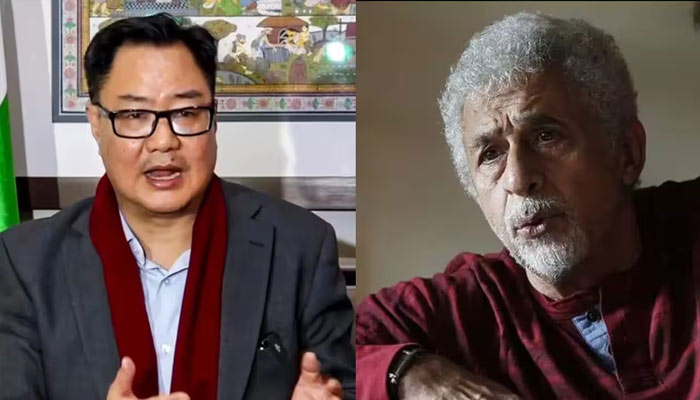
Kiren Rijiju Calls Naseeruddin Shah ‘Urban Naxal’ After Actor Backs Jamia Students’ Protest
Union Minister Kiren Rijiju has criticised veteran actor Naseeruddin Shah over his video supporting students protesting at Delhi’s Jamia Millia Islamia, describing the actor as a “dangerous urban Naxal” and a “subversive intellectual”.
The controversy erupted after Shah, 76, released a video expressing solidarity with Jamia students demanding the restoration of their students’ union. Wearing a badge reading “Dimagi Naxal”, the actor also questioned the Centre’s handling of student protests and raised concerns about the education system and democracy.
Reacting to the video in a post on X, Rijiju said he had previously held the actor in high regard but had changed his opinion after watching his political commentary.
“I used to respect and like Naseeruddin Shah, thinking he was just an ordinary actor. I had no idea that he was a dangerous urban Naxal, a subversive intellectual. I discovered his true character far too late. He is extremely detrimental to India’s democracy,” the minister wrote.
What Did Naseeruddin Shah Say in the Video?
In the video shared on Facebook on Tuesday, Shah openly embraced the label “Dimagi Naxal” while questioning the derogatory terms used against government critics.
“I proudly declare that I am Dimagi Naxal. I don’t know what other nicknames the watchmen have given to people like me, anti-national, tukde tukde gang, and I don’t know what else,” he said in Hindi.
The actor expressed concern over the treatment of students protesting at educational institutions and questioned the government’s response to demonstrations.
“I want to ask this government a question. What else will you do to break the courage of our country’s youth, to destroy the education system, and to put our democracy at risk? How much will you do? How far will you go?” Shah said.
He also referred to protests at Jawaharlal Nehru University (JNU), the Satyajit Ray Film and Television Institute in Kolkata and Jamia Millia Islamia, criticising what he described as the treatment of students.
“First Jawaharlal Nehru University, then Satyajit Ray Film Institute, and now Jamia Millia. The atrocities that are being done on students will be remembered. Everything will be remembered,” he said.
Shah concluded by reciting a line from Sarfaroshi Ki Tamanna Ab Hamare Dil Mein Hai, a poem associated with freedom fighter Bismil Azimabadi: “Dekhna hai zor kitna baazu-e-qaatil mein hai.”
What Does ‘Dimagi Naxal’ Mean?
The expression “Dimagi Naxal” has been used in Indian political discourse to describe intellectuals and individuals accused of supporting or sympathising with Naxalism or Maoist ideology.
Prime Minister Narendra Modi has previously used the term, which has subsequently featured in political exchanges involving the ruling party and its critics.
Shah’s use of the label appeared to challenge the characterisations often directed at people who question government policies or express solidarity with protest movements.
Shah’s Recent Support for Student Protests
The actor has repeatedly spoken out on social and political issues, including student demonstrations and controversies surrounding educational institutions.
Last week, he expressed support for students at the Satyajit Ray Film and Television Institute in Kolkata, where an indefinite protest was underway following incidents of campus violence.
In July, Shah also criticised the government’s handling of protests related to the NEET examination paper leak.
His latest video has brought his support for student movements into the political spotlight, prompting a sharp response from Rijiju.
Why Are Jamia Students Protesting?
Students at Jamia Millia Islamia are demanding the restoration of their students’ union and a clear framework for holding elections.
Their demands include a fixed schedule for student union elections and a definitive deadline for ratifying the union’s constitution.
Elections at the university have not been held since 2006, following incidents of violence on campus.
The dispute has renewed attention on student representation, campus governance and the role of student organisations at Indian universities. Shah’s intervention and Rijiju’s subsequent response have added a political dimension to the ongoing protest.
Comments are closed.