
Love-All in China, Moulded in India: The Inspiring Journey of Badminton Star Tanvi Patri

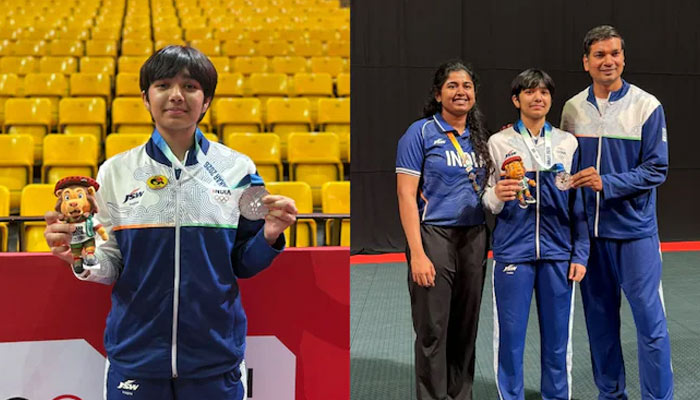
From China to the Youth Olympics Podium: The Journey That Shaped Badminton Prodigy Tanvi Patri
At just 15, Indian badminton player Tanvi Patri has already made her mark on the international stage, becoming the first Indian girl to reach the singles final at the Youth Olympics. Her journey to the silver medal in Dakar, Senegal, is a story of early exposure to badminton in China, family sacrifices and years of dedicated training in India.
Tanvi came agonisingly close to winning gold in an 82-minute final against China’s reigning junior world champion Zhang Yi Xin. After winning the opening game, the Indian teenager lost the second but mounted a remarkable comeback in the decider. Trailing 10-19, she saved five match points to level the score at 20-20. However, Zhang eventually secured a narrow 26-24 victory in the deciding game, winning the match 15-21, 21-13, 26-24.
Despite missing out on the gold medal, Tanvi’s performance marked a significant milestone in her young career. Her ability to challenge an established junior champion highlighted the progress she has made since first picking up a badminton racket as a child in China.
How Tanvi’s Badminton Journey Began in China
Tanvi’s introduction to badminton came when her father, Rabinarayan Patri, was working in Jiangsu province in eastern China. Having grown up in Odisha without adequate financial resources or sporting facilities, Rabinarayan had been unable to pursue his own interest in badminton.
His move to China presented an opportunity to introduce his daughter to the sport. With badminton clubs and coaching facilities widely accessible, Tanvi began learning the basics at a young age.
Rabinarayan also benefited from the coaching environment. While the coaches trained Tanvi, they helped him improve his own playing technique so that he could practise with his daughter outside formal sessions.
Tanvi quickly developed an interest in the game and began participating in local competitions. In 2019, she reportedly competed in around 10 provincial and national-level tournaments in China, winning nine of them. The early success strengthened her confidence and encouraged her family to take her badminton ambitions seriously.
She also developed an admiration for legendary Chinese shuttler Lin Dan, who became her sporting idol.
Father’s Sacrifice and the Move to India
The Covid-19 pandemic brought a major change in the family’s life. The Patri family returned to India and settled in Bhubaneswar. However, Rabinarayan soon realised that Tanvi needed a more competitive training environment to continue progressing.
Despite having a well-paying job in China, he decided to take a risk and prioritise his daughter’s sporting future. His Chinese employers helped him continue working after his return, but the decision involved considerable financial uncertainty.
Tanvi’s mother also eventually left her IT-sector job to manage her daughter’s nutrition, travel and daily routine as the demands of professional badminton increased.
The family subsequently approached the Prakash Padukone Academy in Bengaluru. Following a trial, Tanvi joined its programme in 2021 at the age of 10. Olympic Gold Quest (OGQ) has also supported her development.
Training in Bengaluru Shapes Her Game
At the academy, now known as the Centre for Badminton Excellence, Tanvi began developing the foundation she had acquired in China under a structured coaching programme.
Coach Sagar Chopda, who has worked with her since she joined the academy, was particularly impressed by her footwork, timing and movement around the court.
Her ability to combine attacking and defensive play has gradually become one of her strengths. Rather than relying entirely on powerful smashes, she uses accuracy, placement and shot selection to put opponents under pressure.
The academy’s training environment has also allowed her to learn alongside established players, including Olympic medallist PV Sindhu. Coaches believe that observing experienced international players can help young athletes understand the discipline and intensity required at the highest level.
From Asian Titles to the Youth Olympics Final
Tanvi’s progress has been reflected in her performances across different age groups and international competitions. After winning the Asian U-15 title in 2024, she added the Asian U-17 championship in 2026.
She also began testing herself against senior opponents. At the Pontianak International Challenge in Indonesia, she defeated South Korea’s Kim Min Sun, ranked World No. 71, 21-5, 21-6 in the women’s singles final to claim the title.
Her campaign in 2026 was not without difficulties. Illness affected her performance at the World Junior Championships in Cairo, where she reportedly suffered from a viral fever.
However, she bounced back at the Youth Olympics in Dakar. After defeating Japan’s Yuzuno Watanabe in the semi-final, Tanvi advanced to the gold-medal match against Zhang Yi Xin.
Although she eventually settled for silver, her fightback in the deciding game became one of the standout moments of the tournament.
Coaches Urge Patience as Tanvi Looks Ahead
Despite her achievements, Tanvi’s coaches are cautious about placing excessive expectations on the young shuttler. They believe that physical development, competitive experience and mental resilience will be essential for her long-term progress.
Building strength and staying injury-free remain among the immediate priorities. At 15, Tanvi is still growing, and her training workload needs to be managed carefully to avoid injuries and ensure sustainable development.
Her coaches have also emphasised the importance of allowing her to mature naturally rather than comparing her prematurely with established Indian badminton stars such as Saina Nehwal and PV Sindhu.
For her father, the guiding principle remains simple: focus on personal improvement instead of competing with others.
Tanvi’s journey, which began on badminton courts in China and developed through years of training in Bengaluru, has now taken her to the Youth Olympics podium. The silver medal in Dakar is a major achievement, but for the young Indian shuttler, it could be just the beginning of a much longer journey in international badminton.
Comments are closed.