
Delhi Air Pollution Worsens Ahead of Diwali, AQI Soars Past 400 as Dense Smog Covers Capital

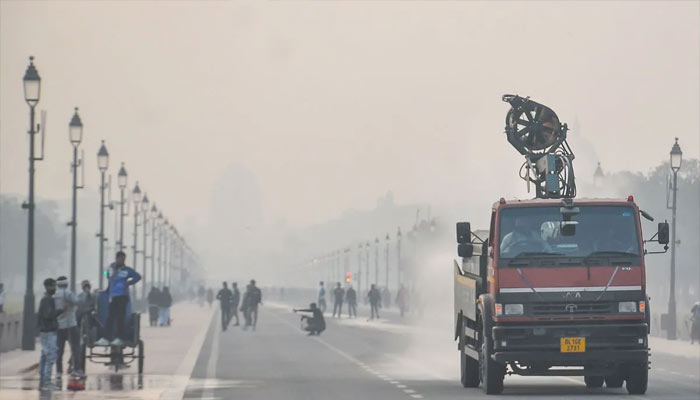
Delhi Pollution Worsens: India Gate AQI Hits 403, 22 Monitoring Stations Report Severe Air Quality
Delhi is witnessing a fresh deterioration in air quality as winter approaches, with pollution levels reaching alarming levels across several parts of the capital. Emissions from vehicles and other local sources, coupled with stubble burning in neighbouring states, continue to add to the pollution load.
The AQI around India Gate was recorded at 403 on Friday, placing it in the ‘severe’ category. As part of efforts to bring down pollution levels, authorities have deployed truck-mounted water sprinklers in the affected areas.
At Anand Vihar, the AQI stood at 350, indicating ‘very poor’ air quality, according to data from the Central Pollution Control Board (CPCB).
Delhi’s 24-hour average AQI was recorded at 369 on Thursday, compared with 377 a day earlier, showing only a marginal improvement in the overall pollution situation.
The CPCB classifies AQI readings of 0-50 as ‘good’, 51-100 as ‘satisfactory’, 101-200 as ‘moderate’, 201-300 as ‘poor’, 301-400 as ‘very poor’ and 401-500 as ‘severe’.
Severe Pollution Forecast For Delhi
The Air Quality Early Warning System (AQEWS) has warned that pollution levels could remain in the ‘severe’ category from Friday to Sunday. Air quality over the following six days is also likely to remain within the ‘very poor’ to ‘severe’ range.
The situation was already critical at several monitoring locations on Thursday. Of Delhi’s 59 active monitoring stations, 22 recorded ‘severe’ air quality.
Punjabi Bagh reported the highest AQI at 459. Other severely polluted locations included Jahangirpuri at 457, Rohini at 453, IIT Delhi at 452 and DTU at 443.
Stubble Burning And Transport Emissions Add To Pollution
According to the Decision Support System (DSS) for Air Quality Management, stubble burning contributed an estimated 15.6 per cent of Delhi’s PM2.5 pollution on Thursday.
Its share is projected to increase to 19.2 per cent on Friday before declining sharply to 1.6 per cent on Saturday.
Transport emissions, however, are expected to account for a larger proportion of pollution in the coming days. Their contribution is forecast to rise from 17.9 per cent on Thursday to 18.3 per cent on Friday and 21.1 per cent on Saturday.
The data highlights the combined impact of agricultural fires and urban emissions on Delhi’s air quality, with transport pollution expected to remain a significant concern even as the contribution from stubble burning declines.
Comments are closed.