
Punjab Farmer Unions Open Up to Political Outreach as Opposition Parties Court Them Ahead of Elections

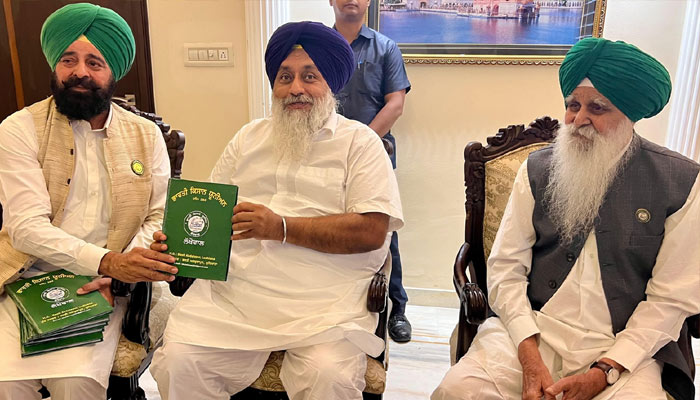
With the 2027 Punjab Assembly elections approaching, political activity around the state’s influential farmer organisations has gained momentum.
Two prominent farm unions have announced their support for the Shiromani Akali Dal (SAD), led by Sukhbir Singh Badal, signalling a departure from the traditional practice of several farmer groups maintaining distance from electoral politics.
The Bharatiya Kisan Union (Kadian), which has a strong presence in the Doaba region, announced its decision to support the SAD on November 2. Its president, Harmeet Singh Kadian, made the announcement during a joint press conference with Badal in Chandigarh.
The move was followed by another significant development on November 18, when the Malwa-based BKU (Lakhowal) also declared its support for the Akali Dal. The announcement came after Sukhbir Badal visited the Ludhiana residence of union president Ajmer Singh Lakhowal.
Farmer Unions and Punjab’s Political Landscape
The decisions by the two organisations have strengthened the SAD’s efforts to reconnect with the farming community ahead of the 2027 elections. They have also revived discussions about the political role of the Samyukta Kisan Morcha (SKM), an umbrella platform of several farmer organisations that led the 2020-21 agitation against the three now-repealed central farm laws.
Although farmer unions have generally attempted to maintain a non-political identity, some organisations and their leaders have previously associated themselves with political parties.
Harmeet Singh Kadian’s father, Partap Singh Kadian, was elected as an SAD legislator in 1968. Similarly, BKU (Mann) leader Bhupinder Singh Mann served as a Rajya Sabha member between 1990 and 1996 after being nominated by the President. Mann has maintained that his nomination was independent of any political affiliation. However, his organisation supported the Congress in the 2002, 2012 and 2017 Assembly elections, as well as the 2019 Lok Sabha polls.
SKM leader Jagmohan Singh Patiala said that although most farmer organisations have preferred to remain outside electoral politics, some unions have supported political parties on different occasions.
He traced the fragmentation of the Bharatiya Kisan Union to 1989, when differences among farmer leaders led to the emergence of several separate organisations, including BKU (Lakhowal), BKU (Dakaunda) and BKU (Ugrahan).
Opposition Parties Step Up Outreach to Farmers
The recent support extended to the SAD has triggered speculation about whether other farmer organisations could also establish political associations ahead of the next Assembly elections. The Congress is reportedly preparing to reach out to these groups, while the BJP has also intensified its engagement with Punjab’s farming community.
However, questions have emerged over the possibility of the SAD entering into an alliance with the BJP. Social activist Narian Dutt of Inqlaabi Manch questioned whether farmer unions supporting the Akali Dal would indirectly extend support to the BJP if the two parties joined hands. He pointed to the deaths of farmers during the protests against the central farm laws as a major concern.
BKU (Lakhowal) general secretary Harinder Lakhowal responded by saying that the organisation would consider the BJP’s position if the party agreed to fulfil its demands. He also referred to the Congress returning to power in Punjab after the events of 1984 and said farmers had supported the AAP in the 2022 elections.
For Ajmer Singh Lakhowal, the decision to support the SAD is not entirely new. He served as chairman of the Punjab Mandi Board from 2007 to 2017, during the SAD-BJP coalition government’s tenure.
The decision has also drawn criticism from the ruling Aam Aadmi Party. AAP general secretary Baltej Pannu questioned Lakhowal’s contribution to farmers’ welfare during his tenure as Mandi Board chairman. He also asked the union leader to explain his plans for addressing farmers’ concerns now that he has extended support to the SAD.
The AAP government led by Bhagwant Mann has faced repeated protests by farmer organisations over various issues. These unions have accused the state government of failing to deliver on several promises related to farmers’ welfare and empowerment.
A farmer union leader told The Indian Express that direct support for the AAP appeared unlikely at present, while Opposition parties were increasingly approaching farmer organisations. The leader added that the Congress’s ability to secure their backing would depend on its plans for protecting farmers’ interests.
The BJP is also making efforts to strengthen its presence among Punjab’s agricultural community. Union Agriculture Minister Shivraj Singh Chouhan has made several visits to the state as part of the party’s outreach to farmers and other stakeholders in the agricultural sector.
Earlier Political Experiment by Farmer Organisations
The relationship between farmer unions and electoral politics has previously created divisions within the movement. Before the 2022 Punjab Assembly elections, the SKM expelled around 22 farmer organisations after they decided to establish the Sanyukt Samaj Morcha (SSM) and contest the polls.
The political initiative failed to secure any of Punjab’s 117 Assembly seats and subsequently became largely inactive. Its formation also contributed to the emergence of the SKM (non-political), which opposed the participation of farmer organisations in electoral politics.
SKM (non-political) convener Jagjit Singh Dallewal said his organisation was established because its ideology did not support political alliances or participation in elections. He maintained that the decision by BKU (Kadian) and BKU (Lakhowal) to back the SAD was their individual choice and again questioned the possibility of an SAD-BJP alliance.
Meanwhile, Harmeet Singh Kadian and Harinder Lakhowal said the SKM had modified its rules after the 2022 elections, allowing constituent unions to independently decide which political party to support. They clarified that the organisations themselves would not contest elections and argued that their members, as voters, were entitled to make their own political choices.
Kadian added that if an individual member of a farmer union decided to contest an election, that person would not be permitted to participate in SKM meetings, although other members of the organisation could continue attending them.
Explaining the decision to support the SAD, Kadian alleged that both the AAP and Congress had failed to adequately address farmers’ concerns. He said his organisation believed a regional party such as the Akali Dal, which upholds the principles of Sri Akal Takht Sahib, could represent the interests of Punjab’s farming community.
With the 2027 Assembly elections approaching, the evolving relationship between farmer organisations and political parties is likely to remain an important issue in Punjab’s political landscape. The decisions of individual unions, their demands and their positions on possible political alliances will shape the debate over the future role of the farming community in state politics.
Comments are closed.