
China Makes History as Shenzhou-24 Carries First Foreign Astronaut, Pakistani National, Into Space

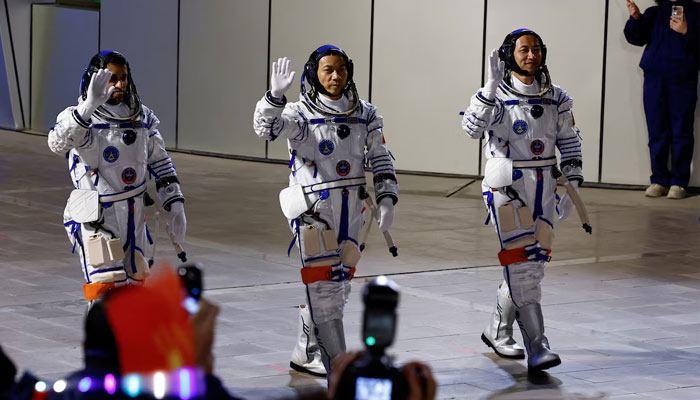
China has achieved a significant milestone in its space programme with the successful launch of the Shenzhou-24 spacecraft on Wednesday.
The mission is particularly historic as its three-member crew includes Pakistani astronaut Zeeshan Ali, who is set to become the first foreign national to travel to China’s Tiangong space station.
The spacecraft lifted off at 8:18 am local time (0018 GMT) from the Jiuquan Satellite Launch Centre in northwest China. It was launched aboard a Long March-2F rocket, marking another important step in Beijing’s efforts to expand its human spaceflight programme.
Zeeshan Ali Set to Become First Pakistani in Space
Ali, a 40-year-old pilot, is part of the mission as a payload specialist. He is expected to spend between five and 10 days aboard the Tiangong space station, where he will participate in scientific experiments and other research activities.
He is accompanied by Chinese astronauts Tang Hongbo, who will serve as mission commander, and flight engineer Wu Yi.
Ali’s participation marks a new chapter in space cooperation between China and Pakistan, while also representing the first time a foreign astronaut has joined a crew travelling to the Chinese space station.
Speaking to reporters ahead of the launch, Ali described the responsibility of representing his country during the historic mission.
“I’m not flying for myself. I carry the name of Pakistan on my shoulder,” he said.
Seven Months of Intensive Training in China
Preparation for the mission involved seven months of rigorous training in Beijing. Alongside technical and operational exercises, Ali underwent intensive Chinese-language lessons to prepare for life and communication aboard the space station.
His training also included learning Chinese songs, reading poetry, practising traditional calligraphy and playing table tennis. The programme was designed to familiarise him with Chinese culture and help him integrate with his fellow crew members.
China Looks to Expand International Space Cooperation
China is increasingly positioning its Tiangong space station as a platform for international scientific partnerships and cooperation. The country’s space programme is seeking to attract foreign participation as it expands its presence in human space exploration.
The development comes as the NASA-led International Space Station approaches a possible retirement around 2030, creating opportunities for alternative platforms in low Earth orbit.
With the inclusion of a Pakistani astronaut, the Shenzhou-24 mission represents an important step in China’s efforts to make Tiangong a centre for international collaboration in space research.
Comments are closed.