
BRICS Nations Slam Trump Tariffs, Blame Them for Global Economic Uncertainty

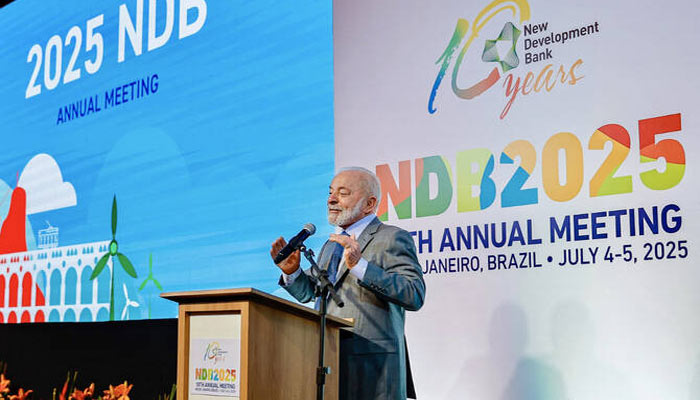
BRICS Summit in Rio Targets Global Trade Tensions, Grapples With Middle East Divisions.
As BRICS leaders gather in Rio de Janeiro from Sunday, the bloc is expected to issue a strong rebuke of protectionist trade policies—particularly those associated with Donald Trump’s tenure—as part of a broader push for a fairer global economic order. However, internal divisions continue to hinder consensus on how to address escalating conflicts in the Middle East.
Comprising nations that represent nearly half the world’s population and 40% of global economic output, the BRICS grouping—Brazil, Russia, India, China, and South Africa—aims to present a united front against what members view as disruptive and unfair U.S. trade practices. Draft statements being circulated by summit negotiators reportedly condemn the economic uncertainty fueled by sweeping tariffs initiated under the Trump administration.
Since taking office, Trump has adopted an aggressive tariff strategy that has targeted both allies and adversaries. His latest move involves formal notices, expected to be sent starting Friday, alerting trade partners to a new round of tariff hikes set to take effect on July 9.
While the final summit communiqué is not expected to explicitly name the United States or Trump, it will unmistakably signal discontent with U.S. trade actions. “We’re anticipating a summit with a cautious tone,” said Marta Fernandez, director of the BRICS Policy Center at Rio’s Pontifical Catholic University. “It will be difficult to mention the United States by name in the final declaration.”
China, which only recently concluded negotiations with Washington over retaliatory tariffs, is reportedly urging restraint to avoid provoking further tensions. “This doesn’t seem to be the right time to provoke further friction between the world’s two leading economies,” Fernandez added.
Xi Jinping and Vladimir Putin to Skip the Summit
The absence of Chinese President Xi Jinping—the first time in his 12 years in office—has notably dampened expectations for the summit’s political weight. Analysts say Xi’s decision may stem from a combination of recent diplomatic engagements, such as his hosting of Brazilian President Luiz Inácio Lula da Silva in Beijing, and the optics of Indian Prime Minister Narendra Modi being given guest-of-honor status at the summit.
“Xi does not want to appear upstaged by Modi, who will receive a state lunch,” noted Ryan Hass, a former China director at the U.S. National Security Council and current analyst at the Brookings Institution. “The simplest explanation may hold the most explanatory power: he’s delegating attendance to Premier Li Qiang based on diplomatic calculations.”
Russian President Vladimir Putin, wanted internationally for war crimes, will also be absent physically but will participate via video link, the Kremlin confirmed.
Lula, who is seeking to position Brazil as a major global player, will view the no-shows as a setback. This year alone, Brazil is hosting the G20 summit, the BRICS summit, and COP30 climate talks—all ahead of a contentious presidential election in 2026.
Middle East Conflicts Expose Divisions Within BRICS
Despite unity on trade, BRICS countries remain divided over their response to ongoing wars in Gaza and between Iran and Israel. Iranian President Masoud Pezeshkian will not attend the summit, though Iranian negotiators are pushing for a stronger statement of solidarity with the Palestinian cause—beyond broad affirmations of peace and two-state solutions.
A source close to the talks indicated that deep divisions remain, particularly over whether to explicitly criticize Israel or the United States.
Artificial intelligence and global health cooperation are also on the agenda, but geopolitical tensions risk overshadowing progress on these fronts.
An Expanded BRICS, With More Voices and More Fault Lines
Originally founded by Brazil, Russia, India, and China, and later joined by South Africa, the BRICS grouping has recently expanded to include Iran, the UAE, Egypt, Ethiopia, and Indonesia. While this enlargement increases the bloc’s global clout, it has also introduced new challenges in achieving consensus.
Brazilian Foreign Minister Mauro Vieira remained optimistic: “BRICS, throughout its history, has managed to speak with one voice on major international issues, and there’s no reason why that shouldn’t be the case this time on the subject of the Middle East.”
As the summit unfolds, all eyes will be on whether BRICS can deliver on that promise—or if its growing diversity will dilute its diplomatic power.
Comments are closed.