
Delhi’s Air Turns Hazardous as AQI Crosses 400 Mark, City Slips Into Red Zone

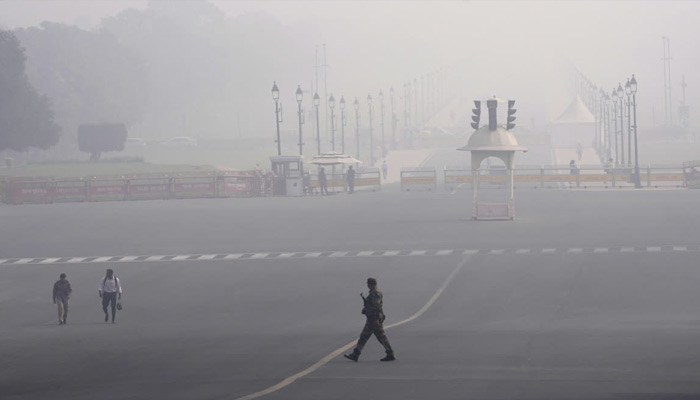
Delhi’s Air Turns Toxic as AQI Crosses 400 in Several Areas; Government Revises Office Timings Amid Crisis.
Delhi’s air quality plunged to alarming levels on Saturday, with several neighbourhoods recording an Air Quality Index (AQI) above 400, placing the national capital firmly in the ‘severe’ category. The thick blanket of smog pushed the city into the ‘red zone’, making it one of the most polluted urban centres in the country.
According to data from the Central Pollution Control Board (CPCB), Delhi’s 24-hour average AQI at 4 pm stood at 361, the second-worst in India on the day. The previous day’s reading was 322. Pollution levels spiked sharply across multiple monitoring stations, with AQI readings of 420 at Wazirpur, 418 at Burari, 411 at Vivek Vihar, 406 at Nehru Nagar, 404 at Alipur, and 402 at ITO — all classified as ‘severe’.
The National Capital Region (NCR) also remained shrouded in smog, as Noida (354), Greater Noida (336), and Ghaziabad (339) recorded ‘very poor’ air quality.
Stubble Burning and Vehicles Drive Pollution Surge
The city’s deteriorating air quality was largely driven by PM2.5 and PM10 particles, the most harmful pollutants. Data from the Decision Support System (DSS) indicated that stubble burning contributed nearly 30% of the pollution load, while vehicular emissions accounted for about 15%.
Satellite data recorded 100 fire incidents in Punjab, 18 in Haryana, and 164 in Uttar Pradesh on Friday — a reflection of ongoing crop residue burning despite curbs. Experts warn that the air quality is unlikely to improve soon, with forecasts from the Air Quality Early Warning System predicting that Delhi will remain in the ‘very poor’ category for the coming days.
Since Diwali, the city’s air quality has oscillated between ‘poor’, ‘very poor’, and occasionally ‘severe’. The CPCB defines an AQI of 0–50 as “good”, 51–100 “satisfactory”, 101–200 “moderate”, 201–300 “poor”, 301–400 “very poor”, and 401–500 “severe”.
Revised Office Hours to Curb Traffic Pollution
In a bid to ease vehicular congestion during peak hours, Chief Minister Rekha Gupta on Friday announced revised timings for government offices.
Under the new schedule, Delhi government offices will operate from 10:00 am to 6:30 pm, while MCD offices will function from 8:30 am to 5:00 pm. The measure aims to reduce traffic density and emissions during rush hours and will remain in effect until February 15, 2026 — covering the months when air quality typically worsens.
The Public Works Department (PWD) has also been directed to deploy 200 truck-mounted anti-smog guns across the city between October 2025 and February 2026 at an estimated cost of ₹58.8 crore. Each gun will spray fine mist twice daily to suppress dust particles. Additionally, all buildings above G+5 floors have been instructed to install anti-smog guns on-site.
Doctors Warn of Cognitive Risks from Smog Exposure
Health experts have cautioned that Delhi’s worsening smog is not only harming lungs but may also be affecting brain function.
“You’re not imagining it if you feel dizzy, foggy, or unusually tired on smoggy days,” said Dr Vinit Banga, Director and Head of Neurology at Fortis Hospital. “Fine PM2.5 particles can enter the bloodstream and travel to the brain, causing inflammation and oxidative stress. This disrupts neuron communication, leading to headaches, irritability, and reduced concentration.”
Comments are closed.