

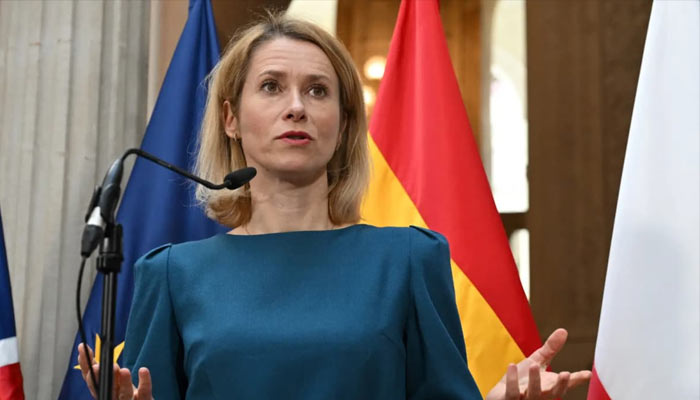
Divided EU Struggles to Agree on Response to Israel Over Gaza War.
European Union foreign ministers on Tuesday discussed potential actions against Israel over the war in Gaza, but internal divisions continue to hinder any concrete decision. The talks, held in Brussels, followed a proposal from EU foreign policy chief Kaja Kallas, who outlined ten possible steps the bloc could take after determining that Israel had breached its human rights obligations under an existing cooperation agreement.
The suggested measures range from suspending the EU-Israel Association Agreement entirely to imposing sanctions on Israeli ministers, restricting trade ties, halting visa-free travel, and enforcing an arms embargo. However, EU diplomats say there is little momentum behind any of the options.
“I can’t predict how the discussion will go,” Kallas said before the meeting, adding that the immediate focus would likely remain on improving humanitarian conditions in Gaza. Kallas recently reached an understanding with Israeli Foreign Minister Gideon Saar to increase the flow of humanitarian aid into Gaza by opening more border crossings and facilitating deliveries of food, water, and electricity.
“There are some positive signs,” Kallas said Monday, citing reopened crossings and increased aid convoys. “But the situation on the ground remains catastrophic. We need to see much more progress.”
Despite the humanitarian steps, the broader political divide within the EU remains stark. While countries like Ireland, Spain, and Belgium have pushed for stronger action against Israel, others, including Germany, Hungary, and the Czech Republic, remain staunch supporters of Tel Aviv.
Saar, speaking in Brussels on Monday, dismissed the threat of EU action. “I’m sure not any of [the proposed steps] will be adopted by the EU member states,” he said. “There’s no justification whatsoever.”
Just reaching the point of formal discussion has been a notable shift for the EU. The bloc only agreed to revisit its association agreement with Israel after military operations resumed in Gaza following the collapse of a temporary ceasefire in March. Until then, deep internal disagreements prevented any coordinated response.
Those divisions remain visible. Hungary, for instance, continues to oppose further sanctions against Israeli settlers in the West Bank, despite a renewed appeal from French Minister Jean-Noël Barrot.
The conflict stems from Hamas’s October 7, 2023, attack on Israel, which left 1,219 people dead — most of them civilians — and saw 251 hostages taken, 49 of whom remain in Gaza. The Israeli military believes 27 of those hostages are dead.
Israel’s retaliatory campaign in Gaza has led to the deaths of at least 58,386 Palestinians, the majority of them civilians, according to the Hamas-run health ministry. The United Nations has described those figures as credible.
As the war continues, pressure is mounting on the EU to take a clearer stance. But for now, consensus appears elusive.
Comments are closed.