
From ‘Pragg’s Sister’ to World Title Contender: R Vaishali Scripts Her Own Checkmate

It is never easy to grow up alongside someone who is as talented as you—sometimes even more so.
Many have felt that quiet comparison: a teacher wondering why you aren’t quite like your sibling, or a casual remark at home turning someone else’s achievement into the benchmark. In classrooms, living rooms, and sporting arenas, the question lingers—what if the other one had done it better?
For 24-year-old Grandmaster R Vaishali, that question was a constant companion. Despite being one of India’s sharpest chess minds, she was often introduced simply as the sister of R Praggnanandhaa.
But in Cyprus, that narrative finally shifted.
By clinching the Women’s Candidates 2026, Vaishali became only the second Indian woman after Koneru Humpy to earn a shot at the World Championship. Later this year, she will challenge China’s reigning champion Ju Wenjun for the ultimate prize.
She arrived as the lowest-rated player in the eight-woman field—a dark horse by every metric. What followed was a performance built as much on resilience as on skill. Across 14 demanding rounds, Vaishali surged late, recovering from a setback in Round 12 before defeating Kateryna Lagno in the final round to seal victory by half a point.
This was not just a tournament win. It was a break from a story that had followed her for years.
The long shadow
Comparisons, in her case, were inevitable.
Praggnanandhaa’s rise was meteoric—youngest International Master, then one of the youngest Grandmasters in history. Vaishali’s journey, though equally demanding, unfolded on a different timeline. Even within Indian women’s chess, milestones came under harsher scrutiny.
Yet, the irony is often overlooked: it was Vaishali who first brought chess into the family.
Coached by R. B. Ramesh and Aarthie Ramaswamy in Chennai, both siblings honed their craft together before becoming part of the WestBridge Anand Chess Academy under the mentorship of Viswanathan Anand.
For a time, Vaishali was the higher-rated player. Then the spotlight shifted. Praggnanandhaa’s rapid ascent brought global attention, and with it, an imbalance in perception. It affected her—as it would anyone—but she adapted, recalibrated, and endured.
The moment in Cyprus
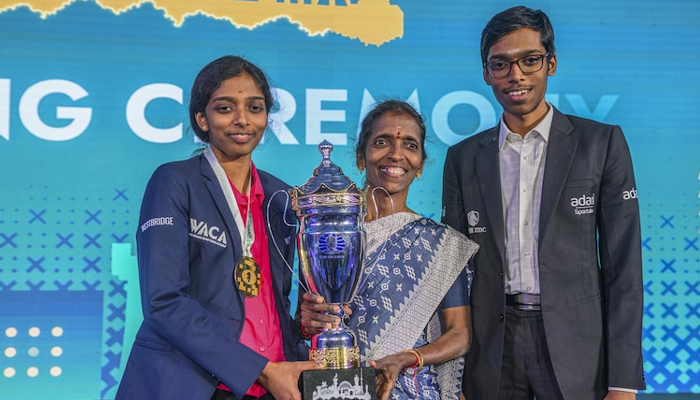
The defining image of her victory wasn’t just on the board.
As she stepped out after the final round, her family was waiting. Her brother, despite a difficult tournament of his own, stood there—supportive, present, and proud.
Later, speaking about her campaign, Vaishali made sure to highlight his role. He tried to downplay it. She didn’t let him.
It was a reminder that beneath the comparisons lies a partnership—one built on shared grind, mutual respect, and quiet understanding.
Years behind the breakthrough
Her triumph in Cyprus was not sudden. It was built over years of steady work, setbacks, and incremental gains.
A key turning point came with her victory at the Grand Swiss, which secured her Candidates spot. From there, preparation intensified—not just technically, but mentally. Structured routines, meditation, and discipline became central to her game.
The Candidates tested all of it.
She took the lead late, stumbled, and then faced the ultimate challenge: recovering under pressure. Where many might have faltered, she reset—mentally and emotionally—and delivered when it mattered most.
Writing her own name
There is a particular weight in being known through someone else’s identity. It takes more than talent to shed it. It takes time, resilience, and the ability to outgrow expectations written by others.
Vaishali has done exactly that.
The World Championship clash against Ju Wenjun will be her toughest test yet. And in a fitting twist, Praggnanandhaa may well be in her corner when that moment arrives.
But Cyprus has already changed something fundamental.
Rameshbabu Vaishali is no longer just “Pragg’s sister.”
She is now a World Championship challenger—on her own terms.
Comments are closed.