

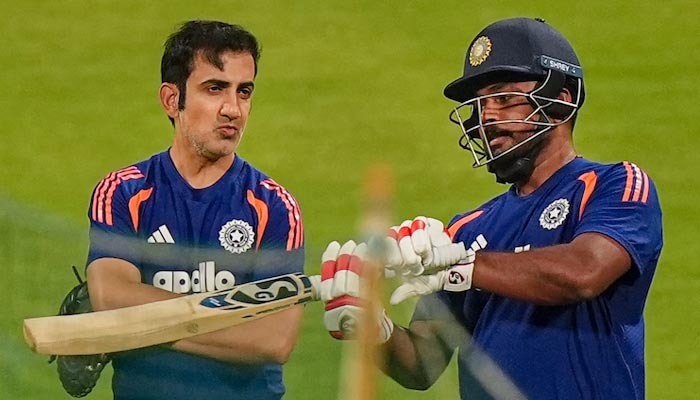
Time Gautam Gambhir Finally Gets the Credit He Deserves.
He may have once famously chosen Marcus Rashford over Cristiano Ronaldo and Lionel Messi in a playful debate, but when it comes to leading India’s T20 revolution, Gautam Gambhir has shown he rarely misses the mark.
On Sunday night in Ahmedabad, as the final New Zealand wicket fell and the Narendra Modi Stadium erupted in a sea of blue, Gambhir allowed himself a rare moment of visible emotion. It wasn’t a grand celebration—just a brief smile—but it was enough to end a 603-day silence on social media.
Moments later, MS Dhoni acknowledged it with a message that felt almost symbolic. “Coach Sahab, the smile looks great on you. Intensity with a smile is a killer combo. Very well done.”
Coming from Dhoni—the ultimate believer in calm processes—it felt like a quiet endorsement for a coach who, for much of the past year, had been portrayed as the villain of Indian cricket’s narrative.
For nearly 18 months, Gambhir has been an easy target for criticism. When New Zealand completed a historic 3-0 Test whitewash in India, the blame landed squarely on his shoulders. When South Africa repeated the feat, questions were raised about his tactical approach. Even a rare ODI series loss in Sri Lanka was framed as evidence that Gambhir was out of his depth.
The label stuck: intense, uncompromising, and perhaps ill-suited to manage a dressing room that had grown comfortable under the calm stewardship of Rahul Dravid. Yet, as India lifted the T20 World Cup on Sunday, Gambhir didn’t look like a man seeking validation. He looked like someone who had simply finished a job.
A Different Philosophy
Earlier in the tournament, Gambhir had dismissed the growing obsession with analytics in modern cricket. “I don’t believe in data, honestly. I have never seen data. I don’t even know what data is all about. T20 is about instinct,” he had said.
Whether that statement reflects his genuine belief or simply serves as a protective shield for his players is open to interpretation. What is undeniable, however, is the result.
Under Gambhir, India have embraced a fearless style of T20 cricket that has pushed scoring boundaries. The team no longer aims for conservative totals. On Sunday, India posted 255 for 5 in the final—the highest score ever recorded in a World Cup final.
In the last two years alone, India have crossed the 250-run mark six times—something no other team in world cricket, including franchise leagues, has managed even four times. Gambhir’s philosophy is straightforward: risk is necessary to dominate.
“If you start fearing defeat, you will never win,” he said after the final. “I would rather accept getting bowled out for 100 than settling for 150 or 160.”
The approach has liberated several players. Sanju Samson and Abhishek Sharma have flourished in a system that prioritises attacking intent over personal numbers. Gambhir has also openly challenged cricket’s long-standing obsession with individual milestones.
“For too long in Indian cricket, we have spoken about milestones,” he said. “As long as I am here, we should celebrate trophies instead.” Samson’s recent scores—97 not out, 89 and 88—illustrate the point. None were converted into centuries, but all helped India produce massive totals.
For Gambhir, that trade-off is the whole point.
Building a New T20 Powerhouse
In an era where public opinion often shapes sporting narratives, Gambhir has chosen to focus inward. “My accountability is not to people on social media,” he said after the World Cup triumph. “My accountability is to the 30 people in that dressing room.”
Behind the scenes, he has made a series of calculated decisions that gradually reshaped India’s T20 structure.
He backed Suryakumar Yadav as captain, prioritising attacking leadership over hierarchy. He revived Varun Chakravarthy’s international career, helping him return as the world’s top-ranked T20 bowler. He persisted with Sanju Samson through inconsistent phases until the Kerala batter eventually became Player of the Tournament.
The changes were not dramatic revolutions. Instead, they were deliberate, quiet adjustments that slowly transformed the team. Even selection calls reflected this philosophy. When the World Cup squad was finalised by Ajit Agarkar’s selection committee, the omission of Shubman Gill stood out.
It wasn’t a dramatic exclusion but a tactical shift. The selectors chose players like Samson and Ishan Kishan, whose aggressive approach aligned with the team’s high-tempo strategy, even though Gill’s pedigree remained unquestioned.
A Legacy in the Making
Despite the criticism he has faced, Gambhir showed notable grace in victory. He dedicated the World Cup triumph to Rahul Dravid and VVS Laxman, acknowledging the foundation they helped build. He thanked the selection committee for backing bold decisions. He even mentioned BCCI secretary Jay Shah as someone who supported him during difficult periods following the Test series defeats.
The numbers now tell a compelling story.
With the 2026 T20 World Cup victory, Gambhir became the first individual in history to win the tournament both as a player (2007) and as a head coach. Under his guidance, India have also secured the 2025 Champions Trophy and the Asia Cup later that year—three major multi-nation titles in just two years.
India’s dominance in T20 cricket today reflects the identity of their coach: fearless, uncompromising and unapologetically aggressive. His methods may divide opinion. His intensity may unsettle critics. But the trophy cabinet offers the clearest argument.
As the celebrations faded in Ahmedabad and the stadium lights dimmed, that brief smile Gambhir allowed himself suddenly felt well deserved.
Comments are closed.