

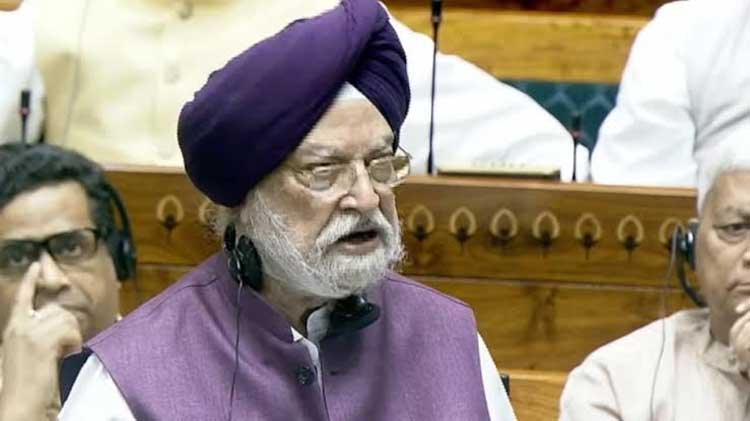
Hardeep Singh Puri told Parliament on Thursday that India has “actively” diversified its imports of liquefied petroleum gas (LPG), or cooking gas, to alternative suppliers including the United States, Norway, Canada, Algeria and Russia, in addition to traditional Gulf sources.
Speaking in the Lok Sabha, the petroleum minister said India earlier imported around 60% of its LPG from Gulf countries such as Qatar, United Arab Emirates, Saudi Arabia and Kuwait, while the remaining 40% was produced domestically. Procurement has now been expanded to multiple suppliers to ensure supply security.
Puri said the government had taken a series of steps to manage disruptions to global energy supplies caused by the ongoing conflict in West Asia. “The world has not faced a moment like this in modern energy history,” he told the House, noting that it had been 13 days since traffic through the strategic Strait of Hormuz — through which about 20% of the world’s crude oil, natural gas and LPG flows — was disrupted following military operations involving Iran, Israel and the United States.
The minister assured lawmakers that India’s crude oil supply remains secure. “Volumes secured exceed what Hormuz would have delivered,” he said, adding that before the crisis roughly 45% of India’s crude imports passed through the strait.
He said sourcing from outside the Hormuz route has increased to about 70% of India’s crude imports, up from 55% before the conflict. India now imports crude from about 40 countries, compared with 27 in 2006–07, giving the country more flexibility to meet demand. Refineries are operating at high utilisation levels, with some exceeding 100%, and there is no shortage of petrol, diesel, kerosene, aviation turbine fuel or fuel oil, he added.
A petroleum ministry official said none of the country’s nearly 100,000 fuel retail outlets are facing shortages.
Puri said natural gas supply is also being managed through prioritised allocation and remains “stable well beyond immediate need”. India produces around 90 million metric standard cubic metres per day (MMSCMD) of gas domestically while consuming about 189 MMSCMD. Imports of roughly 30 MMSCMD from Gulf sources have been affected after a major processing facility in Qatar declared force majeure.
Under the Essential Commodities Act and the Natural Gas Control Order issued on March 9, the government has prioritised supplies. Domestic piped gas to homes and compressed natural gas (CNG) for vehicles will receive full supply with no cuts, while industrial consumers will receive up to 80% of their previous six-month average and fertiliser plants up to 70%. Refineries and petrochemical units will absorb limited reductions.
The minister said additional LNG cargoes are arriving almost daily through alternative routes, ensuring enough supply even if the conflict continues. “Power generation for every household and for industry is fully protected,” he added.
To secure cooking gas supplies, the government issued an LPG Control Order on March 8 directing refineries to maximise LPG output and supply it exclusively to the three state-run oil marketing companies — Indian Oil Corporation, Bharat Petroleum Corporation Limited and Hindustan Petroleum Corporation Limited. As a result, LPG production has increased by 28% in the past five days, Puri said.
The three companies together serve more than 33 crore domestic LPG customers through over 25,000 distributors across the country.
“Modi government’s foremost priority is that the kitchens of India’s 33-plus crore families, especially the poor and underprivileged, do not face any shortage,” Puri said, adding that the delivery cycle for domestic cylinders remains unchanged at about 2.5 days. Hospitals and educational institutions have also been placed on uninterrupted priority supply.
He warned that recent reports of shortages were largely driven by panic buying rather than actual supply disruptions. Commercial LPG sales have been temporarily regulated to prevent hoarding and black-marketing in the deregulated market.
A three-member committee comprising executives from IOC, BPCL and HPCL was formed on March 9 to assess demand and coordinate allocations with state governments. The panel has decided that 20% of the average monthly commercial LPG requirement will be supplied initially to ensure genuine users receive fuel first.
Puri said alternative fuels such as kerosene, biomass, RDF pellets and coal have been suggested for the hospitality sector for about a month to help conserve LPG for priority consumers.
“This is not the moment for rumour-mongering or fake narratives,” the minister said. “India is navigating the most severe global energy disruption in recorded history.” He added that crude supplies remain steady, gas is prioritised for homes and farms, and LPG production has been ramped up while consumer prices remain far below international levels.
Comments are closed.