
‘LOI’ Shines in a Brilliant Stage Production at Veda Kunba Theatre, Mumbai

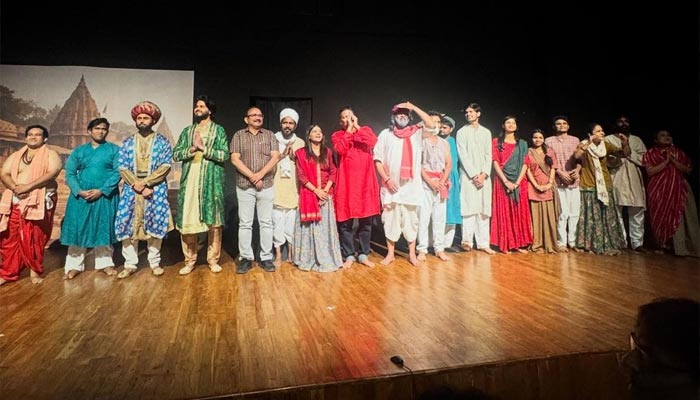
The Hindi play ‘LOI’ was powerfully and poignantly staged at Veda Kunba Theatre, leaving a lasting impression on Mumbai’s theatre enthusiasts.
Written by noted poet-lyricist Pratap Somvanshi and directed by Akashaditya Lama, with co-direction by Vikram TDR, the play explores the life of Loi—a bold, questioning woman from 15th-century Kashi, remembered largely as the companion of Kabir.
Breaking away from conventional portrayals, the narrative reclaims Loi as a fiercely independent voice who challenged patriarchy, caste hierarchies, and religious orthodoxy. Drawing inspiration from Shekhar Sen’s celebrated solo play Akashaditya Lama crafts a layered and compelling story that places Loi at the center of social and philosophical resistance.
The play vividly depicts her defiance against entrenched authority—whether confronting orthodox priests or questioning the rule of Sikandar Lodi. One of its most striking elements is Loi’s fearless interrogation of even Kabir’s own dohas when they appear critical of women, adding a bold, introspective dimension to the narrative.
The climax unfolds in the royal court of Sikandar Lodi, where Loi emerges as a powerful voice against communal divisions and gender oppression. Her impassioned appeal for humanity and equality resonates deeply, making it the emotional high point of the production.
The ensemble cast—including Vikram TDR, Mitali Nag, Mukul Nag, Aditi Mishra, Punesh Tripathi, Sohail Malia, Mehreen Saba, Apurva Mahesh, Reshma Mestry, Durgesh, Prateek Mahalle, and Arunoday Vajpai—delivered nuanced performances that elevated the production. The actor portraying Loi stood out for embodying the character’s intellect, defiance, and compassion with remarkable depth.
Akashaditya Lama’s direction ensured a tight narrative flow while preserving the play’s ideological intensity. The intimate setting of Veda Kunba Theatre further enhanced the immersive experience, transporting the audience to the spiritual and social landscape of 15th-century Kashi. Somvanshi’s dialogues, sharp and unflinching, bridged past and present with striking relevance.
Widely appreciated by Mumbai’s theatre community, ‘LOI’ goes beyond being a historical retelling—it serves as a powerful reflection on contemporary society, championing equality, questioning injustice, and celebrating the enduring spirit of humanity. The resounding applause at the end testified to its profound impact.
Comments are closed.