

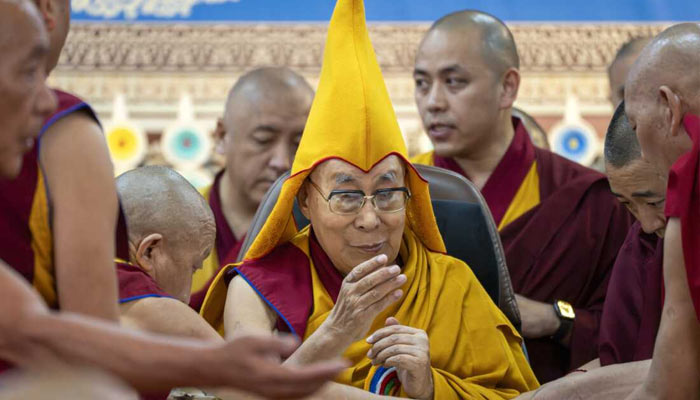
Dalai Lama at 90: Meaning of the Title, His Succession Plan, and China’s Opposition.
As the 14th Dalai Lama, Tenzin Gyatso, approaches his 90th birthday on July 6, celebrations have begun at Tsuglagkhang Temple in McLeodganj, the spiritual headquarters of Tibetan Buddhism in exile. Alongside the festivities, a critical announcement by the Dalai Lama about his succession has reignited tensions with China, which insists on asserting control over the spiritual leader’s reincarnation.
What Does ‘Dalai Lama’ Mean?
Though widely seen as the global face of Buddhism, the Dalai Lama is actually the spiritual head of the Gelug school, one of four major schools of Tibetan Buddhism.
According to the Namgyal Monastery, the term “Dalai Lama” combines the Sino-Mongolian word dalai, meaning “ocean” or “big sea”, and the Tibetan word bla-ma, meaning “guru” or “teacher.” Together, the title implies a teacher whose wisdom is as vast as the ocean.
Historically, the title was conferred by Mongol chief Altan Khan on the third Dalai Lama as a symbol of spiritual and political alliance. Since then, the Dalai Lamas have been regarded by Tibetans as reincarnations of Avalokiteśvara, the bodhisattva of compassion, known as Chenrezig in Tibet, Guanyin in China, and Kannon in Japan—the one who “hears the cries of the world.”
While the early Dalai Lamas were primarily religious teachers, the fifth Dalai Lama also assumed political leadership of Tibet, a dual role that continued until China’s occupation in the 1950s.
His Succession Plan—and China’s Rejection
On July 2, the Dalai Lama reaffirmed his stance on succession, asserting that the Gaden Phodrang Trust—a body established by his office in 2015—will hold the sole authority to recognise his future reincarnation.
“I hereby reiterate that the Gaden Phodrang Trust has the sole authority to recognise the future reincarnation. No one else has any such authority to interfere in this matter,” the Dalai Lama said in a 5.5-minute video message in Tibetan, released by his office.
This declaration rules out any role for external powers, especially China, in determining his successor. The move is significant as the Dalai Lama had earlier suggested the possibility of ending the institution altogether or having a female or non-Tibetan successor.
China’s Response: The ‘Golden Urn’ Tradition
Beijing swiftly rejected the Dalai Lama’s announcement. Chinese Foreign Ministry spokesperson Mao Ning insisted that any future Dalai Lama must be chosen through the ‘Golden Urn’ process, a system introduced during the Qing dynasty in the 18th century, under which the names of potential reincarnations are drawn by lot in a ritual sanctioned by the central Chinese government.
“The reincarnation must follow domestic recognition, the Golden Urn process, and approval by the central government,” Mao said at a media briefing in Beijing.
This reflects China’s broader strategy of controlling Tibetan religious institutions as part of its effort to consolidate authority over the Tibet Autonomous Region.
Why This Moment Matters
The Dalai Lama had earlier said that at age 90, he would assess whether the spiritual lineage should continue. His decision to go forward with the succession plan now carries spiritual, political, and cultural weight—not just for Tibetans, but for Buddhists worldwide.
As the birthday celebrations continue, so does the decades-long dispute between Tibetan spiritual authority and Chinese political control—a struggle now poised to intensify in the years ahead.
Comments are closed.