
“New Study Suggests Mars Exerts Greater Impact on Earth’s Climate Than Previously Thought”

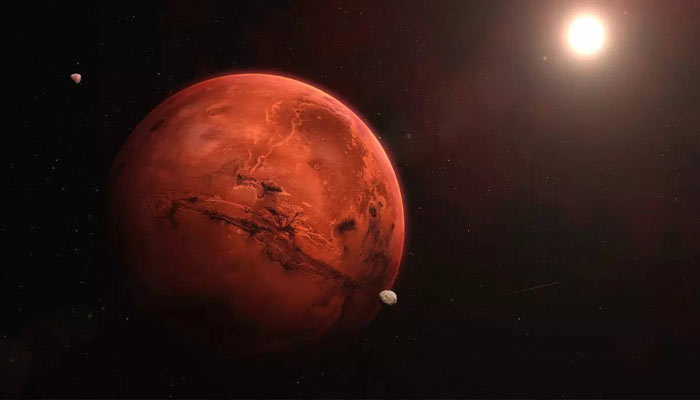
Study Reveals Mars Has a Stronger Role in Shaping Earth’s Climate Than Previously Thought
New simulations suggest that Mars exerts a far greater influence on Earth’s climate than scientists had previously believed. The Red Planet’s gravity affects Earth’s tilt and orbit, playing a crucial role in long-term climate cycles that span hundreds of thousands to millions of years. Despite being smaller than giants like Jupiter, Mars helps shape Earth’s climate over vast timescales, according to Space.com.
For decades, scientists have known that Earth’s long-term climate is governed by Milankovitch cycles—slow changes in Earth’s orbit and axial tilt caused by the gravitational pull of other planets. Venus, because of its proximity, and Jupiter, due to its enormous mass, were long considered the dominant drivers. Mars was thought to play a minor role, but its true impact remained unclear.
Previous studies of deep-sea sediments hinted at Mars’ involvement, but its magnitude had not been fully quantified. To investigate, researchers Stephen Kane (University of California, Riverside), Pam Vervoort (University of Birmingham, UK), and Jonathan Horne (University of Southern Queensland, Australia) ran advanced simulations.
Understanding Milankovitch Cycles
Milankovitch cycles operate over millions of years and are unrelated to modern human-induced climate change. They drive major shifts, including ice ages, by altering three key aspects of Earth’s movement:
Axial tilt (obliquity) – the angle of Earth’s axis relative to its orbit.
Orbital eccentricity – how elliptical Earth’s orbit is around the Sun.
Precession of the equinoxes – the timing of Earth’s closest approach to the Sun, which gradually shifts over millennia.
Mars’ Unexpected Impact
The simulations confirmed that while Mars has little effect on the 430,000-year orbital cycle—dominated by Venus and Jupiter—it plays a crucial role in two other cycles, lasting roughly 100,000 years and 2.4 million years. Removing Mars from the simulation eliminated these cycles entirely. Increasing Mars’ mass shortened the cycles, amplifying its influence.
Mars also helps stabilize Earth’s axial tilt. As Mars’ mass increases in the simulations, the pace of tilt changes slows. This challenges the long-held assumption that Earth’s large Moon is the primary stabilizing force. Earth’s tilt normally oscillates between 21.5° and 24.5° every 41,000 years, while Mars’ tilt is far more irregular. The study suggests that Mars’ gravitational pull helps keep Earth’s tilt relatively stable.
Finally, Mars’ position in the solar system enhances its effect. Kane explained that, despite its smaller size, Mars’ distance from the Sun allows it to exert a stronger gravitational influence on Earth than previously thought.
These findings reshape our understanding of how planetary interactions influence Earth’s long-term climate and highlight Mars as a key player in stabilizing our planet over millions of years.
Comments are closed.