

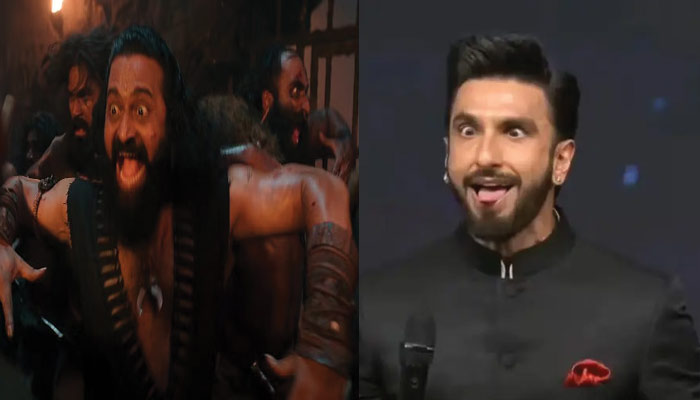
Weeks after Ranveer Singh apologised for mimicking daivas during an event, Kantara director-actor Rishab Shetty has spoken out, saying it makes him “uncomfortable” when elements of his culture and traditions are enacted without understanding.
Shetty, speaking at a recent event, emphasised that Daivas are sacred and should not be mocked or performed casually. “That makes me uncomfortable. While much of the film is cinema and performance, the daiva element is sensitive and sacred. Wherever I go, I request people not to perform it on stage or mock it. It is emotionally deeply connected to us,” he said.
Although Shetty did not mention anyone by name, his comments came shortly after Ranveer Singh faced criticism for imitating the popular Chaundi moment from Kantara at IFFI. During the session, Singh referred to the character as a “female ghost,” crossed his eyes, stuck out his tongue, and added a “primordial scream,” while Shetty laughed beside him. Singh even joked, “Anybody here want to see me in Kantara 3? Tell this guy,” pointing at Shetty.
The clip quickly went viral, prompting netizens to express disappointment. Singh later apologised, stating: “I intended to highlight Rishab’s incredible performance in the film. Actor to actor, I know how much it would take to perform that particular scene the way he did, for which he has my utmost admiration. I have always deeply respected every culture, tradition, and belief in our country. If I’ve hurt anyone’s sentiments, I sincerely apologise.”
Why the Chaundi Scene Is Culturally Sensitive
In Kantara, Chaundi appears in one of the film’s most intense and spiritually rooted sequences as Guliga Daiva’s fierce and protective sister. The scene combines ritual movements, trance-like energy, and coastal folklore, making it deeply significant within Tulu and Bhoota Kola traditions. Chaundi represents divine rage and ancestral spirit, which is why many consider any mockery of the portrayal disrespectful.
Comments are closed.