
Strait of Hormuz crisis threatens global economy as US‑Israel‑Iran conflict escalates

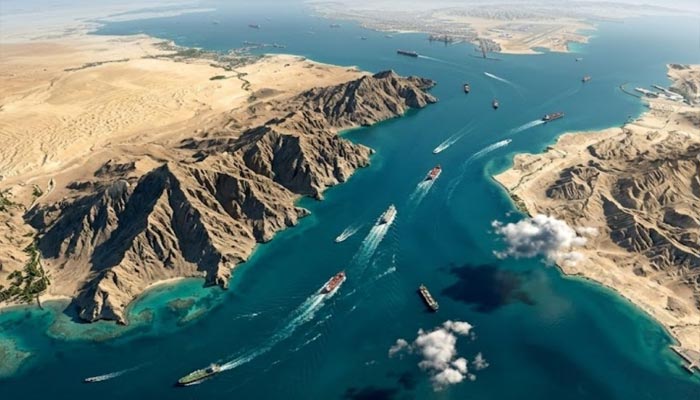
Amid escalating attacks on Iran by the United States and Israel, and Tehran’s retaliatory actions across the Gulf, the world’s attention has turned to the Strait of Hormuz—a narrow waterway just 33 km wide at its narrowest point, yet critical for the global economy.
Here’s a breakdown of why the Strait of Hormuz matters and what the current tensions mean for global energy security, especially for India.
What is the Strait of Hormuz?
The Strait of Hormuz connects the Persian Gulf to the Gulf of Oman and, beyond that, the Arabian Sea and Indian Ocean. Iran lies to the north, while Oman and the UAE form its southern coast. Despite its slim width—two 2-mile traffic lanes separated by a 2-mile buffer—the strait handles enormous volumes of maritime trade.
All major Persian Gulf oil exporters—including Saudi Arabia, Iraq, Kuwait, the UAE, Qatar, Bahrain and Iran—must route their crude through this single passage. There is no overland alternative or bypass canal capable of handling this volume. Simply put, the Strait of Hormuz is irreplaceable for crude oil exports.
Why the Strait is a global energy chokepoint
Approximately 20 million barrels of crude oil—around 20% of global consumption—transit the Strait of Hormuz daily. It also carries nearly 20% of the world’s LNG, much of it from Qatar, along with petroleum products and refined fuels. At any moment, dozens of supertankers navigate its waters.
Limited alternatives
- Saudi Arabia’s East-West Pipeline to the Red Sea carries 5–7 million barrels per day.
- The UAE’s Abu Dhabi Crude Oil Pipeline handles roughly 1.5 million barrels per day.
- Combined, these routes cannot replace the volume that normally passes through Hormuz.
The Iran factor
Iran’s coastline forms the northern bank of the strait. Tehran maintains a strong naval presence, including anti-ship missiles, drones and sea mines. Historically, Iran has threatened to close Hormuz during crises—most notably over US nuclear sanctions. While the strait remains open for now, any hint of disruption sends oil prices spiking 20–40% in the short term.
Strait of Hormuz and India
India is heavily dependent on seaborne crude, with no major pipeline alternatives. Its refineries—including the world’s largest at Reliance Industries Ltd.—are designed for Gulf oil grades. Iraq, Saudi Arabia, and the UAE supply over a million barrels daily through Hormuz.
Crude oil accounts for nearly 85% of India’s total imports, making the country the world’s third-largest consumer. India holds 9.5 million barrels in strategic reserves, enough for 9–10 days, and commercial reserves provide roughly 74–75 days of supply—still below the IEA’s recommended 90 days. Any disruption in Hormuz would strain this delicate balance.
Dual threats
Non-Gulf oil imports from the US and Venezuela pass through the Red Sea via the Suez Canal, which is under threat from Houthi activity.
Around 90 lakh Indians live in Gulf countries, so ongoing tensions endanger both remittances and lives.
Strategic significance
The Strait of Hormuz has long been a geopolitical flashpoint. During the 1980s Iraq-Iran war, the “Tanker War” saw attacks on vessels navigating the strait. Today’s crisis represents the most severe escalation in the region since the 1991 Gulf War.
In short, the Strait of Hormuz is not just a narrow waterway—it is a geopolitical and economic lifeline. Any further escalation could disrupt the flow of oil, LNG and global trade, sending ripple effects across economies worldwide.
Comments are closed.