
U.S. Push for Venezuela’s Oil Raises Global Warming Alarm
Venezuela holds more than 300 billion barrels of proven crude oil reserves — the largest in the world — yet its output has sagged to roughly 1 million barrels per day, far below past peaks of more than 2–3 million bpd

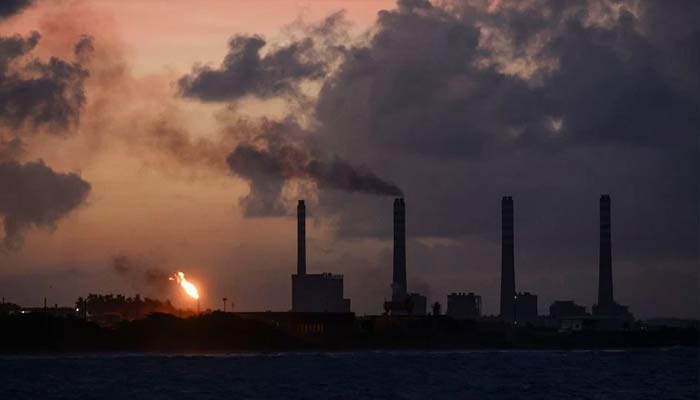
Days after US forces entered Venezuela and detained President Nicolás Maduro, Washington is now turning its focus to the country’s vast oil reserves.
With President Donald Trump openly backing direct involvement by American energy companies. Trump has argued that renewed oil production would also benefit the Venezuelan people. Energy and climate analysts, however, remain sceptical. While improved technology and stricter emissions controls could limit some damage, they warn that the economic and environmental costs of exploiting Venezuelan oil remain prohibitively high.
Venezuela presents a paradox that deeply concerns climate scientists. The country holds the world’s largest proven crude oil reserves — more than 300 billion barrels — yet production has collapsed over the past decade, falling from about 2 million barrels per day in 2016 to less than 1 million barrels today.
This decline has been driven by years of US sanctions, chronic underinvestment and decaying infrastructure. Oil pipelines, storage tanks and refineries are often decades old and poorly maintained, leading to frequent leaks and spills that have contaminated rivers, lakes and surrounding land.
“Venezuela’s oil is considered ‘dirty’ not because of ideology, but because of physics and infrastructure,” Guy Prince, head of energy supply research at the think tank Carbon Tracker, told CNN.
He added that the biggest climate impact of renewed intervention may not be the immediate release of new carbon, but the broader consequences. “It risks distracting from the clean energy transition, reinforcing a 20th-century resource-conflict mindset and creating instability that slows coordinated climate action,” Prince said.
According to the International Energy Agency, methane emissions from Venezuela’s oil and gas sector are six times the global average.
Most of the country’s crude comes from the Orinoco Belt, which contains extremely heavy oil. Extracting and refining it requires significantly more energy than conventional crude, resulting in higher pollution levels and carbon emissions.
Experts warn that scaling up production would worsen both climate and environmental damage. Kevin Book, managing director at ClearView Energy Partners, told NPR that Venezuelan oil poses not just technical challenges but economic ones as well. “It’s not just a geologic or engineering problem — it’s a math problem,” he said, noting that aggressive drilling strategies have often failed financially.
Patrick King, head of emissions research at Rystad Energy, said US oil majors do have experience in reducing emissions in some global operations. However, their ability to do so in Venezuela would be limited.
Rystad Energy estimates that simply maintaining Venezuela’s current low production levels would require more than $53 billion over the next 15 years to repair aging wells, pipelines and equipment.
The American Fuel & Petrochemical Manufacturers trade group notes that around 70 per cent of US refining capacity is configured for heavy crude — a factor that could make Venezuelan oil commercially attractive. But long-term demand remains uncertain, particularly if electric vehicles and clean energy technologies continue to expand, potentially flattening or reducing global oil consumption.
“There are limits to how much emissions can be reduced,” King said.
Diego Rivera Rivota, a senior research associate at Columbia University’s Center on Global Energy Policy, warned that expanded production would almost certainly drive up emissions. “Most likely, carbon emissions would increase very significantly,” he said.
Even with better oversight and modern management, experts say Venezuelan oil could be made less polluting — but never clean. With an interim government now in place, Trump has made clear that cooperation is expected. US Energy Secretary Chris Wright said on Wednesday that Washington intends to restart oil flows quickly.
“We’re going to get that crude moving again and sell it,” Wright said. “We will market the crude coming out of Venezuela — first the stored oil, and then production going forward.”
Comments are closed.