
UN Security Council Faces Pressure to Stop Gaza Violence Amid Political Stalemate

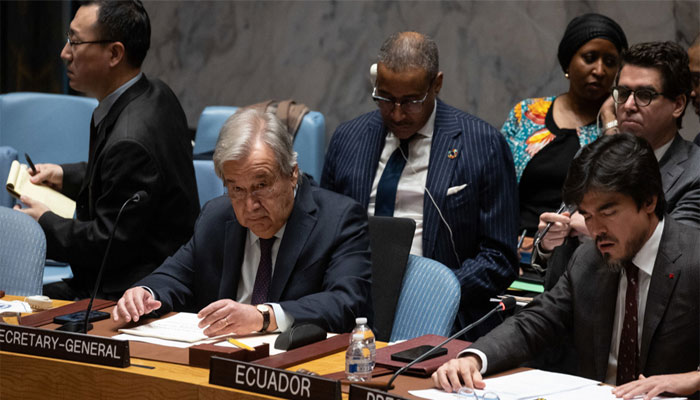
The UN Secretary-General Antonio Guterres on Tuesday described the ongoing violence in Gaza as “one of the darkest chapters of the Israeli-Palestinian conflict,” warning that nearly two years.
After the Hamas attacks of Oct. 7 and Israel’s military response, the situation across the Occupied Territories has worsened, threatening regional and global peace.
Guterres highlighted the escalating humanitarian crisis in Gaza City. “Famine is a reality, with the population constantly forced to move and being starved,” he told the UN Security Council. He called the situation “untenable, morally and legally indefensible,” adding that violence is spreading from Gaza to the West Bank and beyond, including Qatar.
Efforts to secure a ceasefire and release hostages, led by Qatar, Egypt, and the US, suffered a setback on Sept. 9 following an Israeli attack on Doha, Guterres said, calling it a violation of Qatar’s sovereignty that undermined diplomacy.
He warned that the viability of a two-state solution is “steadily eroding,” with settlement expansion, forced displacement, and cycles of deadly violence pushing the region close to a point of no return. Guterres specifically criticized Israel’s approval of settlements in the E1 area, which could sever the contiguity of a future Palestinian state, calling the settlements a “flagrant violation of international law.”
The Palestinian Authority faces an existential crisis, he added, citing withheld tax revenues, a collapsed economy, and declining donor aid, leaving it unable to pay salaries or provide basic services. Guterres urged urgent international financial and political support to stabilize the PA and maintain it as a viable partner for peace.
Guterres acknowledged a “glimmer of hope” from the recent High-Level International Conference on Palestine, co-chaired by France and Saudi Arabia, which he said revived political momentum toward a two-state solution based on pre-1967 borders with Jerusalem as a shared capital. He called for an immediate halt to settler expansion and annexation threats, in line with International Court of Justice rulings.
Saudi Arabia’s UN ambassador Abdulaziz Alwasil described Gaza as “a catastrophic situation deteriorating day by day” due to ongoing military escalation and siege, and criticized the international community for failing to hold Israel accountable. He urged the UNSC to enforce accountability measures and support a two-state solution.
Slovenia’s Foreign Minister Tanya Fajon condemned the Security Council’s paralysis, warning that Gaza exemplifies the failure of the international community, calling it “the deadliest place for children, humanitarian workers, and journalists” and the site of the Middle East’s first-ever proclaimed famine.
Danish Foreign Minister Lars Lokke Rasmussen stressed the need for Israel to change course immediately and for the council to work collectively to save lives, noting last week’s US veto against a ceasefire resolution. He emphasized ongoing efforts by the US, Qatar, and Egypt to broker peace.
UK Foreign Secretary Yvette Cooper highlighted Britain’s recognition of Palestine as a step to protect the two-state solution and promote a just and lasting peace.
US Ambassador Mike Waltz demanded Hamas release all hostages, cease harming civilians, and disarm, while criticizing the Palestinian Authority for failing to meet basic Oslo commitments and for seeking unilateral recognition of statehood, which he said rewarded Hamas for refusing to surrender.
Comments are closed.