
UNSC Unanimously Approves Measures to Stop Houthi Drone and Missile Production

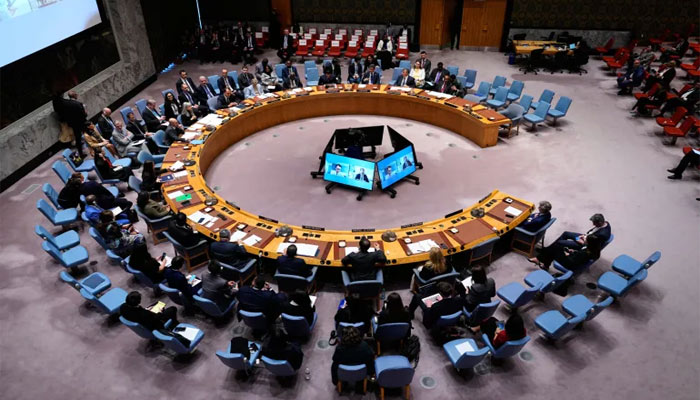
UN Security Council Extends Yemen Sanctions, Moves to Restrict Houthi Access to Drone and Missile Components
The United Nations Security Council has unanimously renewed sanctions on Yemen and approved steps aimed at restricting the Houthi militia’s access to dual-use components and chemicals used in manufacturing drones and missiles.
The resolution, adopted by consensus on Thursday, condemned the Houthis’ military escalation within Yemen, cross-border attacks on Saudi Arabia and threats to commercial shipping. It called on the group to end its offensive operations and halt attacks threatening regional security.
Under the resolution, targeted asset freezes and travel restrictions on designated Houthi members will remain in force until November 14, 2027. The mandate of the panel of experts monitoring the sanctions has also been extended until December 15, 2027. The arms embargo imposed on the militia under Resolution 2216 in April 2015 remains in place without a fixed expiry date.
British Ambassador to the UN Sarah MacIntosh said the unanimous adoption reflected the Security Council’s resolve to respond to Houthi attacks in Yemen, Saudi Arabia and the wider region. The UK is responsible for leading the council’s work on Yemen.
She said the measures would ensure that the sanctions framework responds to the militia’s growing military capabilities, particularly its use of commercially available components and precursor chemicals to manufacture weapons locally.
UN monitoring experts have reported that the Houthis obtain military supplies through smuggling networks and the diversion of commercially available equipment. This has helped the group expand domestic weapons production and reduce its reliance on external sources.
The Security Council is expected to determine by January 11 which measures member states should adopt to prevent the acquisition of specific dual-use items. The expert panel will prepare a list of components and materials that could be brought under restrictions.
MacIntosh said the UK would consult other council members to reach an agreement on the proposed list in the coming months.
The resolution also tasked the expert panel with examining revenue streams generated by the Houthis through their control of important economic sectors. The investigation is intended to identify how these funds may be used for military activities and recommend measures to prevent such diversion.
Another provision warns that the arbitrary detention of UN staff, diplomats and humanitarian workers by the Houthis could lead to additional sanctions. The issue gained urgency following the death in Houthi custody of Mohammad El-Shami, a Yemeni employee of the UN Human Rights Office. He had been detained since June 6, 2024, and his family was informed only recently that he had died more than a month earlier.
MacIntosh condemned the continued detention of UN, humanitarian, civil society and diplomatic personnel and reiterated the UK’s demand for their immediate and unconditional release.
Differences During Negotiations
Although the resolution was eventually adopted without objections, negotiations exposed differences among Security Council members.
The UK initially sought to restore language describing the Houthis as a “terrorist group”, a designation included in earlier sanctions resolutions since 2022. However, it withdrew the proposal after Russia argued that such wording could complicate political negotiations.
Bahrain, supported by the United States, also sought to include the designation, but the proposal did not make it into the final text.
China and Russia raised objections to the proposed restrictions on dual-use items and the expansion of the expert panel. References to alleged links between the Houthis and Somalia-based Al-Shabaab were also removed following objections from African council members, China and Russia.
Yemen’s UN Ambassador Abdullah Al-Saadi welcomed the council’s condemnation of Houthi actions but expressed disappointment that members had not agreed to explicitly identify the group in stronger terms.
He referred to the militia’s record of attacks on civilians, cross-border strikes and threats to international shipping. Al-Saadi also accused the Houthis of using starvation as a weapon of war and called for an end to their prolonged siege of Taiz.
He warned that the resolution would not absolve those supporting the militia of responsibility for its actions.
Renewed Fighting Raises Regional Concerns
The Security Council’s decision comes amid a fresh escalation in Yemen’s conflict. The Houthis launched an offensive in early September and, after several days of clashes with government forces, captured the strategic Red Sea port of Mokha, according to the account presented during the council proceedings.
The developments have strengthened the militia’s position along Yemen’s Red Sea coastline and near the Bab al-Mandeb Strait, a strategically important passage for international maritime trade.
The group has also carried out missile and drone attacks on Saudi territory, including civilian airports and oil facilities at Yanbu on the Red Sea coast. The attacks came amid wider regional tensions following Iran’s blockade of the Strait of Hormuz during the conflict involving the United States and Israel that began in February.
MacIntosh highlighted the worsening humanitarian situation in Yemen, saying more than 22.3 million people required assistance and over 330,000 had been displaced by the latest fighting.
“Sanctions are not an end in themselves,” she said, describing them as an instrument to restrict those threatening Yemen’s peace and security.
Al-Saadi, meanwhile, stressed that the resolution’s effectiveness would depend on its implementation, particularly whether it could translate into concrete action to stop weapons supplies from reaching the Houthis.
Comments are closed.