
Virat Kohli to Novak Djokovic: How the Power of Visualisation Fuels Sporting Greatness

“When you want something, all the universe conspires in helping you to achieve it,” Paulo Coelho famously wrote in The Alchemist.
Legendary India batter Sachin Tendulkar echoes a similar sentiment: “Dreams do come true, if you chase them hard.” But is this just poetic optimism, or does it hold real-world weight — especially in sports?
In the fiercely competitive world of athletics, physical skill and conditioning often take centre stage, but mental strength is the hidden differentiator. Among the psychological tools elite athletes swear by, one stands out for its transformative impact — visualisation, also called guided imagery. It’s the mental practice of picturing yourself excelling under pressure, and then replicating that performance in reality.
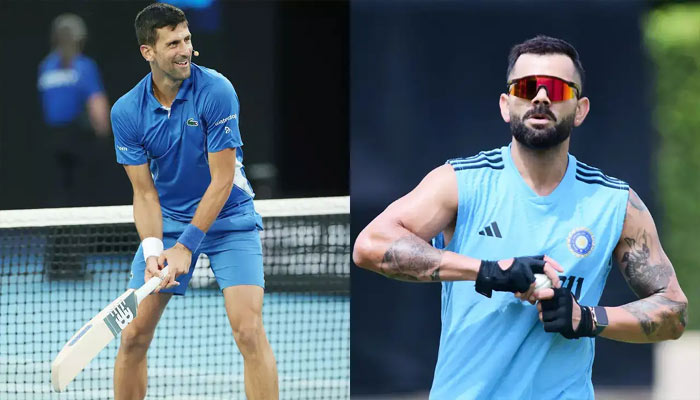
From Virat Kohli and Novak Djokovic to Conor McGregor, Cristiano Ronaldo, and Michael Phelps, many of sport’s greatest icons have harnessed visualisation to sharpen their game. Sports psychiatrist Dr. Chinmay Patkar explains that guided imagery works best when practised consistently under expert supervision, helping athletes prepare mentally for the rigours of competition.
How Visualisation Works
In scientific terms, visualisation is guided imagery — immersing yourself in a detailed mental rehearsal of peak performance. “Find a quiet place, calm your breathing, and imagine your ideal scenario,” says Dr. Patkar. The key is detail: the texture of the pitch, the grip of the bat, the sound of the crowd, even the smell of freshly cut grass. The brain processes this vivid simulation much like a real event, priming the body’s reflexes for actual performance.
Virat Kohli used this method after a tough 2014 England tour. Before facing Australia later that year, he imagined dominating Mitchell Johnson — and went on to score 692 runs, his career-best in a Test series. “You can’t just show up and see what happens,” Kohli said. “You have to convince yourself you can do it.”
Novak Djokovic, after his gruelling 2019 Wimbledon final win over Roger Federer, revealed that he had “played the match in his mind” beforehand, picturing himself lifting the trophy despite the partisan crowd.
Proven Impact on Performance
The technique is more than motivation — it’s a performance enhancer. Conor McGregor famously visualised his 13-second knockout of José Aldo at UFC 194, even rehearsing the exact left-hand counter that would seal the fight. Michael Phelps, the most decorated Olympian ever, mentally swam each race thousands of times before entering the pool, preparing not only for perfect conditions but also for worst-case scenarios, like a goggle malfunction.
Dr. Patkar notes that such mental rehearsals sharpen instincts, reduce reaction times, and prepare athletes for split-second decisions. However, he warns against trying it for the first time just before a major event. “Start weeks in advance so by game day, your mind is already in the zone,” he says.
More Than Just Imagination
Visualisation is backed by neuroscience and sports psychology research. It doesn’t replace physical training, but complements it by reducing anxiety, boosting confidence, and creating a mental “blueprint” for success. For athletes facing high-stakes moments, it’s an edge that can separate victory from defeat.
In an era where margins are razor-thin, mastering the mental game is no longer optional. The world’s best athletes aren’t just training their bodies — they’re training their minds to see success before it happens. And more often than not, reality follows vision.
Comments are closed.