
War or Peace? Putin Faces Diverging Views at Russia’s Flagship Economic Summit

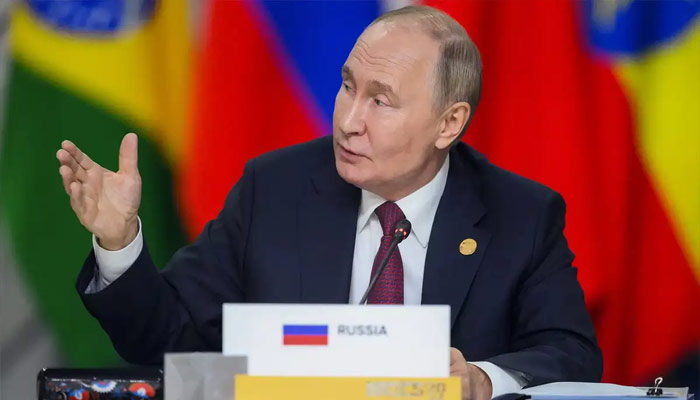
President Vladimir Putin presided over Russia’s flagship investment forum in St Petersburg on Thursday.
Where competing visions over the country’s future in the war with Ukraine played out sharply among political and business elites.
The St Petersburg International Economic Forum—often described as Russia’s answer to Davos—became a platform for contrasting arguments: some participants called for continued military engagement and long-term confrontation with the West, while others pointed to mounting economic strain and advocated a path toward ending the conflict.
The debate unfolded against the backdrop of an ongoing war in Ukraine that has dragged on for more than four years, reshaping Russia’s economy, foreign relations and domestic political discourse. Despite signs of economic stagnation, hardline voices at the forum insisted that Russia must prepare for a prolonged period of confrontation.
“We will be at war in the next few years, maybe for a couple of decades,” said Andrey Bezrukov, a former intelligence officer, adding that Russia should adapt to what he described as a sustained global struggle. His remarks drew applause from sections of the audience, underscoring the influence of nationalist sentiment within parts of the Russian establishment.
Others at the forum, however, warned that the costs of prolonged conflict were becoming increasingly difficult to ignore. Some participants argued that economic slowdown and battlefield stalemate should push Moscow toward exploring a negotiated settlement, potentially with international mediation.
The St Petersburg forum, once dominated by Western financiers and global corporations, has in recent years reflected Russia’s shifting economic and geopolitical isolation. This year’s edition featured exhibitions of military equipment, drones, and surveillance technologies, highlighting the increasing overlap between economic policy discussions and defence priorities.
Russia currently controls a significant portion of Ukrainian territory following its 2022 invasion, though advances on the battlefield have slowed. The war has left large parts of eastern Ukraine contested, with Kyiv continuing to reject any recognition of Russian sovereignty over occupied regions.
While the Kremlin maintains that it has no intention of expanding the conflict beyond Ukraine, hardline nationalist figures at the forum framed the war as part of a broader, long-term confrontation with the West. Ideologue Alexander Dugin said the conflict would end only with “victory or never,” reflecting the uncompromising stance of Russia’s most hawkish voices.
The competing perspectives at the forum underscored the strategic crossroads facing Moscow, as President Putin continues to balance economic pressures with domestic political factions advocating divergent paths on the war.
Comments are closed.