

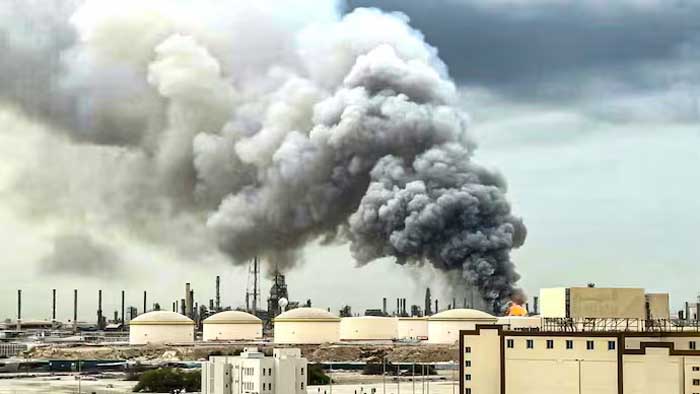
Iran’s strike on Qatar’s key energy hub at Ras Laffan Industrial City—in retaliation for an Israeli attack on the South Pars Gas Field—poses fresh challenges for India, which relies heavily on imports for its energy needs, sourcing over 88% of its crude oil and about half of its natural gas from abroad.
The conflict had already disrupted supplies from Qatar, India’s largest gas supplier, which accounts for roughly one-third of its LPG imports and about half of its LNG imports. Earlier disruptions were largely due to shipping constraints around the Strait of Hormuz, but damage to infrastructure at Ras Laffan now raises longer-term concerns, as repairs could take time even after hostilities ease.
The extent of disruption will ultimately depend on how severely facilities at Ras Laffan have been hit, since restoration timelines will determine when LNG and piped natural gas supplies can normalise.
Indian companies such as Petronet LNG, GAIL, and Gujarat State Petroleum Corporation have long-term contracts with Qatar. Petronet LNG imports around 7.5 million tonnes per annum (MTPA) of LNG, while GSPC imports about 1 MTPA and GAIL less than 1 MTPA.
Qatar also supplies around 5 million metric tonnes of LPG annually to Indian firms, including oil marketing companies. In 2024–25, it remained India’s largest LNG supplier, exporting fuel worth $6.39 billion, and its top LPG supplier, with shipments valued at $3.21 billion. India also imports petrochemicals such as ethylene, propylene, ammonia, urea, and polyethylene from the Gulf nation.
The ongoing tensions have hit India’s energy sector on two fronts—supply disruptions and price pressures. With reduced imports, natural gas is being diverted to priority segments like domestic PNG and CNG for transport, leaving industrial users facing shortages.
India produces about 90 million metric standard cubic metres per day (MMSCMD) of natural gas but consumes roughly 189 MMSCMD. Imports—around 30 MMSCMD from Gulf sources—have been impacted following force majeure declared by a major Qatari facility.
While the government is working to secure alternative supplies, fuel prices are under pressure. LPG rates have already been increased by state-run oil companies, even as petrol and diesel prices remain unchanged despite the Indian crude basket crossing $146 per barrel.
Interestingly, Indian crude prices have surged well above global benchmarks. While Brent crude was at $103.42 per barrel earlier, it jumped 5.6% to $113.39 following the Iranian strike on Ras Laffan.
To manage the situation, Indian refiners have stepped up diversification, sourcing LPG and LNG from countries such as the US, Norway, Canada, Algeria, and Russia instead of relying predominantly on Gulf suppliers like Qatar, the UAE, Saudi Arabia, and Kuwait.
Despite these efforts, Qatar remains a crucial trade partner. In 2024–25, bilateral trade stood at $14.14 billion, with India importing $12.46 billion worth of goods—primarily energy products—and exporting $1.68 billion. Key Indian exports include cereals, iron and steel products, machinery, gems and jewellery, and vehicles.
The evolving situation in the Gulf will continue to shape India’s energy security outlook, particularly if infrastructure damage in Qatar leads to prolonged supply disruptions.
Comments are closed.