
2nd T20I: Tilak Shuts Down Critics as India’s Batting Depth Strategy Delivers

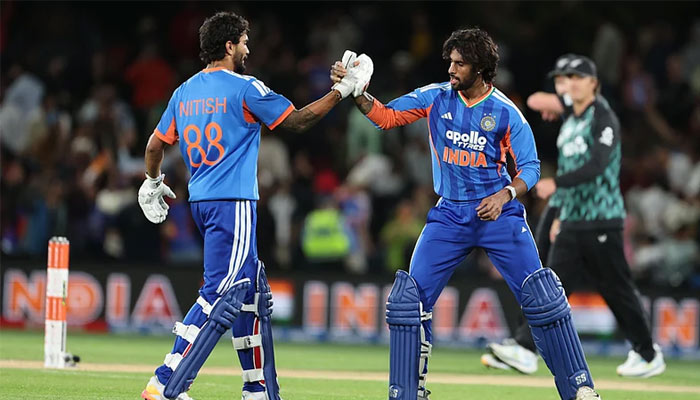
India’s strategy of strengthening its batting line-up delivered another telling result as Tilak Varma produced a match-winning unbeaten half-century to guide the team to a thrilling four-wicket victory over.
New Zealand in the second T20I at Christchurch. The win gave India a commanding 2-0 lead in the five-match series. Tilak, who had faced criticism for his slow six off 12 balls in the series opener, responded emphatically with an unbeaten 51 off just 26 deliveries. His innings, featuring six fours and a six, demonstrated his ability to handle pressure and accelerate when the situation demanded it.
The left-hander found an able partner in Nitish Kumar Reddy as the duo added an unbeaten 69 runs for the seventh wicket. Their crucial partnership rescued India from a precarious position at 112/6 and took the team to 181/6 in 19.5 overs, with just one ball remaining.
Tilak’s celebration after completing the chase appeared to be a pointed response to his critics. The vice-captain first gestured for silence before covering his ears, underlining the importance of his performance after the scrutiny he faced following the opening match.
India’s top order struggled against New Zealand’s disciplined bowling attack. Sanju Samson scored 14, while Vaibhav Sooryavanshi managed only four on his return to the playing XI. Abhishek Sharma and the other middle-order batters also failed to establish a substantial partnership, leaving India under pressure.
Naman Dhir once again provided an important contribution, scoring 31 off 17 balls. Having smashed 51 off 16 deliveries in the first T20I, Dhir continued his aggressive approach before falling to Mitchell Santner in the 15th over. His dismissal left India needing another substantial contribution to stay in the contest.
Tilak, who was batting on 10 off nine balls at the end of the 16th over, gradually shifted gears. He allowed Reddy time to settle before launching an assault on Nathan Smith in the penultimate over, collecting 18 runs through a six and three boundaries. The equation came down to 11 runs from the final over, and Reddy held his nerve to finish unbeaten on 26 off 13 balls.
Earlier, India’s bowlers made an encouraging start after captain Shreyas Iyer elected to field. Arshdeep Singh dismissed Tim Seifert for seven, Bhuvneshwar Kumar removed Daryl Mitchell for six, and Prince Yadav bowled Finn Allen for 16 as New Zealand slipped to 41/3 inside the powerplay.
However, Glenn Phillips and Bevon Jacobs steadied the innings with a fourth-wicket partnership of 116 runs from 77 deliveries. Phillips struck 70 off 43 balls, including four fours and four sixes, while Jacobs contributed 58 off 46 balls, hitting five fours and a six.
India missed an opportunity to break the partnership when Shreyas Iyer dropped Jacobs on 20 in the 11th over. The reprieve allowed the New Zealand batters to rebuild and accelerate, putting their side in a strong position before Arshdeep dismissed Phillips in the 18th over. Jacobs was removed shortly afterwards by Nitish Reddy, while Michael Bracewell added an unbeaten 10 off just two deliveries to take New Zealand to 180/5.
Arshdeep finished with figures of 2/33, while Prince Yadav claimed 1/30. Bhuvneshwar conceded 50 runs in four overs but accounted for Mitchell, and Reddy’s dismissal of Jacobs proved crucial in the closing stages.
Iyer also showed greater flexibility in his bowling choices, using six bowlers after relying on fewer options in the series opener. Naman Dhir was introduced for an over soon after the powerplay and conceded only seven runs, helping India maintain control during a crucial phase.
Ultimately, the victory highlighted the value of India’s additional batting options. While the top order struggled and the middle order failed to build momentum, Reddy and Tilak demonstrated how a deeper batting line-up can turn a difficult chase into a winning performance. For Tilak, the innings was also a timely reminder that one difficult outing does not define a player’s ability to deliver under pressure.
Comments are closed.