

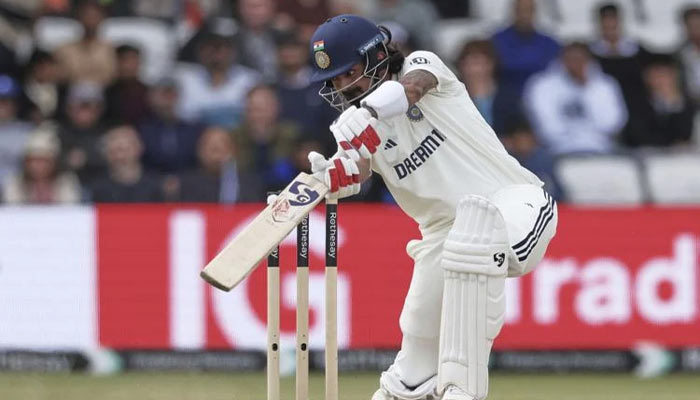
KL Rahul’s Headingley Classic: The Quiet Pillar of India’s Test Renaissance.
KL Rahul didn’t flinch when he said it at the post-Day 4 press conference at Headingley.
No drama, no resentment—just a calm acceptance of a reality he’s come to embody over years of Test cricket.
“I had forgotten what my actual position is.”
That wasn’t a complaint. It was a truth spoken by a man who has spent his career adapting. He’s been benched, recalled, promoted, demoted—batted everywhere from opener to No. 6, and kept wickets when asked. Through it all, Rahul has remained one thing: available. Unfazed. Undemanding.
And finally, at Headingley, all that patience crystallized into something lasting.
A Calm in the Chaos
Day 4 didn’t begin well for India. Shubman Gill—centurion and new captain—was dismissed in the very first over. England had the new ball, a lively crowd, and a pitch misbehaving just enough to make India twitch.
But Rahul didn’t. He already knew the script. He had seen it before. With Yashasvi Jaiswal at one end and the scoreboard under pressure, Rahul did what he’s quietly mastered—he steadied the ship.
While Rishabh Pant dazzled with his counterpunching flair, Rahul anchored. His 137 was measured, meticulous, and most of all, mature. No flash, no theatrics—just control. He left well, defended softly, punished width. His 195-run partnership with Pant didn’t just rebuild—it reasserted.
This was Rahul’s third Test hundred in England—the most by any Indian opener on these shores. But more than a statistic, it felt like a validation of his entire Test journey.
Standing Tall Against Stokes
Rahul’s innings gained even more weight because of the challenge: Ben Stokes.
The England skipper, dangerous in rhythm and always up for a contest, attacked with bouncers, movement, and menace. He changed angles, sought reverse swing, and tried to rattle the Indian vice-captain.
Rahul didn’t blink.
He didn’t fight fire with fire. He won with clarity—leaving when he had to, ducking when required, and driving with precision when Stokes overpitched. His 29 runs through the covers were a visual ode to timing. Not a shot was forced. Not a single movement was flustered.
He didn’t overpower Stokes. He outthought him.
When Red-Ball Cricket Is Personal
Rahul has always been candid about his love for the format.
“I love red-ball cricket. You can’t take that away from me,”
he told Nasser Hussain in an interview with Sky Sports.
And it shows.
There’s a different rhythm to Rahul in whites. More methodical. Less urgent. As if each delivery is a quiet dialogue with the game he loves most. He respects the silence between balls. At Headingley, that reverence came alive—his innings was a study in balance and discipline.
From Spare Part to Central Figure
For years, Rahul has been Indian cricket’s contingency plan. Plugging gaps. Covering injuries. Taking gloves when Pant or Saha were unavailable. Shifting spots depending on who was injured, dropped, or rested.
But now, as India enters a transitional era—Kohli and Rohit in the twilight, a new captain in Gill—Rahul’s value feels more permanent. Not because he’s flashy, but because he’s foundational.
Eight of his nine Test hundreds have come as an opener. Five in SENA countries. In England, his average as an opener now stands at 43.11. That’s not just consistency—that’s calibre.
The Glue in the Noise
In a cricketing world loud with brands, noise, and narratives, KL Rahul offers an anomaly: stillness. His Headingley hundred wasn’t a viral moment. It was a message. That amid change, his quiet stability is irreplaceable.
You need an opener?
He’s ready. A middle-order anchor?
He’s game. A keeper? He’ll oblige.
In this evolving Indian Test team, Rahul doesn’t demand a role—he earns it. Slowly, silently, and steadily.
At Headingley, he didn’t just score a hundred. He reminded everyone why Test cricket still rewards character. And why KL Rahul, in his own unassuming way, remains one of its most trustworthy keepers.
Comments are closed.