
Dalai Lama’s Reincarnation Strategy Seen as Buffer to Han Expansion in Tibet

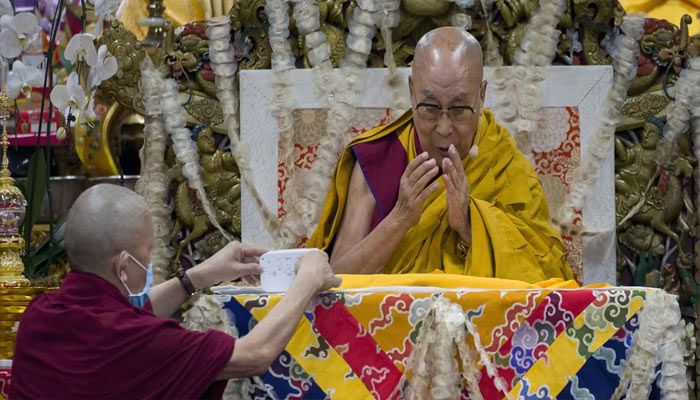
Dalai Lama’s Reincarnation Plan: A Spiritual Blow to China’s Control in Tibet.
As the 14th Dalai Lama, Tenzin Gyatso, enters his 90th year on July 6, his decision to reincarnate outside of Chinese-occupied Tibet represents a historic assertion of Tibetan religious sovereignty—and a potent check on Beijing’s efforts to consolidate cultural and political control over the Himalayan plateau.
By reaffirming his intent to reincarnate, the Dalai Lama has not only revived the 445-year-old spiritual institution but also offered renewed hope to over six million Tibetan Buddhists, many of whom have lived under Chinese occupation since the 1950 annexation of Tibet. His message is clear: Tibetan Buddhism will not be dictated by Communist Party edicts, nor will it surrender its spiritual legacy to political coercion.
Defying Beijing’s Shadow
The Dalai Lama’s declaration that the process of his reincarnation will be overseen by the Gaden Phodrang Trust—his official spiritual and cultural institution in exile, led by Samdhong Rinpoche—ensures that the next Dalai Lama will be born in a free land, not under China’s authoritarian control. This effectively nullifies Beijing’s attempts to hijack Tibetan religious succession using its controversial “Golden Urn” method and state-imposed religious laws.
It also sidesteps contentious debates surrounding the Panchen Lama—recognized by Tibetans but missing since 1995—and the Chinese-appointed alternative, Gyaltsen Norbu, who was prominently showcased by Xi Jinping in June 2025. The reincarnation decision strategically avoids overlap with existing schisms, reaffirming spiritual legitimacy over state endorsement.
Why It Matters Now
Beijing had long hoped that the Dalai Lama institution would fade after the 14th reincarnation. But the 2025 announcement—echoing his global stature and spiritual continuity—has caught Chinese leadership off guard. While China is expected to anoint its own Dalai Lama using controlled religious figures and the ‘Golden Urn’ narrative, the Tibetan diaspora and much of the global Buddhist community are unlikely to accept any such puppet figure.
This development is not merely religious—it is a challenge to China’s efforts to erase Tibetan identity, assimilate culture, and expand the Han demographic and military presence across Tibet’s strategic terrain.
The Historical and Political Context
The institution of the Dalai Lama dates back to 1578, forged in a spiritual alliance between Sonam Gyatso and Mongol leader Altan Khan. Dalai Lamas are considered incarnations of Avalokiteshvara, the Bodhisattva of Compassion, and serve as both spiritual and temporal leaders of Tibet.
While the Qing dynasty introduced the “Golden Urn” system in 1792 to exert control, Tibetans have largely rejected this method. Notably, the 14th Dalai Lama was not chosen using this system.
Steps Toward the 15th Dalai Lama
Reincarnation in Exile: His Holiness has stated his successor will be born outside China—likely in India or among Tibetan refugee communities—to preserve the autonomy of the search process.
Gaden Phodrang Trust Oversight: The search will be guided by the Dharamsala-based trust, independent of Chinese interference.
Open to a Female or Living-Appointed Successor: The Dalai Lama has expressed openness to a female reincarnation or designating an “emanation” while still alive, bypassing traditional vulnerability.
Separation of Church and State: Since 2011, the Dalai Lama has relinquished political authority to the democratically elected Sikyong of the Central Tibetan Administration, reinforcing spiritual purity in leadership.
Rejection of China’s Legal Framework: Beijing’s 2007 law mandating state approval of all reincarnations is firmly denounced by the Tibetan spiritual leadership as an infringement on religious freedom.
What Lies Ahead
Two Dalai Lamas?: A dual-reincarnation scenario appears inevitable—one recognized by the exiled Tibetan leadership and its global supporters, and another backed by the Chinese Communist Party.
The Search Beyond Tibet: Likely locations include Tibetan refugee settlements in India, Nepal, Bhutan, and Mongolia.
International Recognition Will Be Key: With strong global support behind the legitimate successor, China’s influence over Tibetan Buddhism could be increasingly marginalized.
Conclusion
As Beijing pushes forward with its program of Sinicization and hard-line policies in Tibet, the Dalai Lama’s reincarnation decision is a peaceful yet profound act of resistance—one that reasserts Tibetan spiritual sovereignty and ensures the enduring flame of its identity will not be extinguished, even in exile.
Comments are closed.