
Macron Declares France-UK Unity Will ‘Save Europe’ as He Begins State Visit to Britain

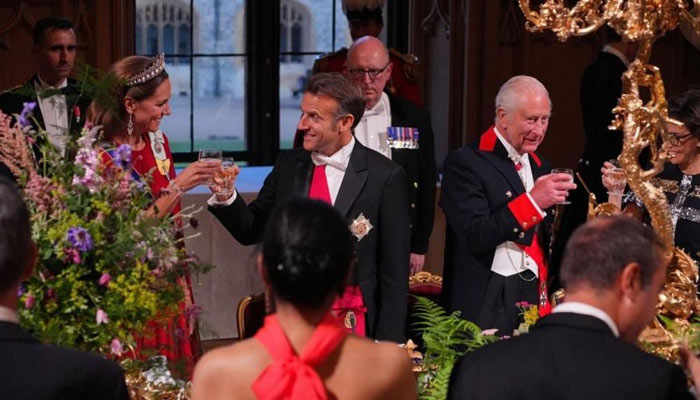
Macron Begins UK State Visit with Bold Message: France and Britain Must ‘Save Europe.’
French President Emmanuel Macron, during his state visit to the United Kingdom, called on Britain to remain closely aligned with its European neighbors despite its exit from the EU. In a pointed address to British lawmakers on Tuesday, Macron declared that France and the UK must “save Europe” by upholding democracy, the rule of law, and global order in an increasingly unstable world.
A Call for Unity Amid Global Shifts
Speaking in the ornate Royal Gallery of Parliament, Macron emphasized that both nations represent “a world order based on law, justice, and respect for territorial integrity — an order that is under daily assault.” He urged renewed Franco-British cooperation to address shared challenges, stating, “The United Kingdom and France must once again show the world that our alliance can make all the difference… we will save Europe by our example and our solidarity.”
Despite Brexit, Macron asserted that Britain cannot remain detached from European affairs. “Security, democracy, and competitiveness — the very core of our identity — are interconnected across the continent,” he said.
Royal Welcome, Diplomatic Depth
Macron’s three-day visit, at the invitation of King Charles III, marks the first UK state visit by a European Union head of state since Brexit. The trip is rich in symbolism, reflecting an effort to reset relations between London and Brussels after years of post-Brexit friction.
The French president and his wife, Brigitte Macron, received a warm ceremonial welcome. Greeted by Prince William and Princess Catherine upon arrival, they were later received by King Charles and Queen Camilla at Windsor Castle. The royal couple hosted a formal banquet in their honor, with guests including political leaders and cultural icons such as Mick Jagger and Elton John. The evening featured a nod to the historic 1904 “Entente Cordiale” with a gin-based cocktail aptly named “L’entente.”
King Charles, maintaining the monarchy’s political neutrality, nonetheless noted the joint efforts of France and the UK to support Ukraine and address complex threats, including irregular migration.
Migrant Crisis and Security Talks
The state visit transitions into more serious diplomatic discussions on Wednesday and Thursday, when Macron meets Prime Minister Keir Starmer. Talks will focus on migration control, defense cooperation, and strategic investments — notably, French energy giant EDF’s 12.5% stake in a new UK nuclear plant.
Among the most pressing topics is irregular migration across the English Channel. Macron and Starmer are expected to discuss enhanced enforcement efforts on French shores, including potential new bilateral agreements. A “one-in, one-out” migrant exchange proposal is also under consideration, aiming to balance humanitarian responsibilities with security concerns.
France and the UK have long cooperated to combat human smuggling networks, but migrant crossings remain persistent. Over 20,000 people have made the perilous journey across the Channel in 2025 alone — a 50% increase from the same period last year.
Ukraine and the European Security Architecture
A key agenda item is continued support for Ukraine. Macron and Starmer are central figures in a European-led initiative to establish a post-ceasefire peacekeeping force — a concept that has seen lukewarm interest from Washington but growing traction in Europe.
British officials insist the so-called “coalition of the willing” remains viable, with Macron and Starmer scheduled to join a multilateral virtual summit on Thursday to advance plans for such a force.
“Europeans will never abandon Ukraine — never,” Macron said, reaffirming his commitment to defending democratic values in the face of Russian aggression.
A Cultural Gesture
In a nod to shared history, Macron announced that France would loan the famed Bayeux Tapestry to the UK — its first journey across the Channel in more than 900 years. The 70-meter-long embroidery, which chronicles the Norman conquest of England in 1066, will be displayed at the British Museum from September 2026 to July 2027.
Comments are closed.