

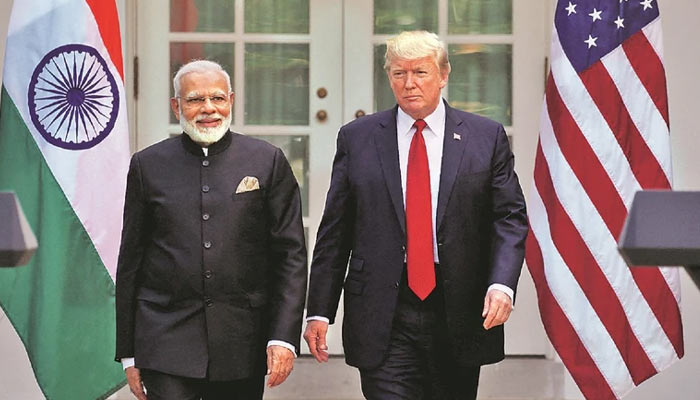
India on Thursday firmly denied former US President Donald Trump’s claim that Prime Minister Narendra Modi had assured him over a phone call that New Delhi would stop purchasing oil from Russia.
The Ministry of External Affairs (MEA) clarified that no such phone conversation took place between the two leaders, rejecting Trump’s remarks made during a White House briefing a day earlier.
“At this point, we have already issued a statement on this. As far as a telephone or a conversation between the two leaders is concerned, there was no phone call between them yesterday,” the MEA said during its media briefing.
Trump had claimed that during a recent conversation, PM Modi assured him that India would halt Russian oil imports — calling it “a big step” in efforts to isolate Moscow over the Ukraine war. “He assured me today that they will not be buying oil from Russia. That’s a big step. Now we’re going to get China to do the same thing,” Trump had said, adding that he and Modi shared a “great relationship.”
The Indian government, without directly addressing Trump, reiterated that its energy policy is shaped by national and consumer interests, focusing on securing supplies and maintaining stable prices. “India’s decisions on energy procurement are guided by market realities and the needs of our people,” the MEA said in a statement.
Trump’s claim quickly snowballed into a political controversy in India. Opposition leader Rahul Gandhi accused the Prime Minister of appearing “weak” before Washington, alleging that Modi had allowed Trump to dictate terms on multiple occasions. Gandhi cited previous incidents, including India’s muted responses to US pressure on various geopolitical issues.
Moscow, meanwhile, expressed support for New Delhi’s stance. Russian Ambassador to India Denis Alipov said that India’s energy cooperation with Russia remains consistent with its national interests, adding that decisions about oil imports are “for the Indian government to make.”
The controversy comes as Washington continues to pressure India to cut back on Russian crude purchases, which account for nearly one-third of India’s total imports. Trump has even imposed steep tariffs — totaling up to 50 percent — on Indian goods in response to what he described as India’s “funding” of Moscow’s military campaign in Ukraine.
The trade tensions have complicated talks on the long-pending US-India Bilateral Trade Agreement (BTA), though both sides are reportedly exploring ways to resume dialogue.
For now, India’s message remains unchanged: its energy choices will continue to prioritize the country’s economic stability and consumer welfare, regardless of external political pressure.
Comments are closed.