

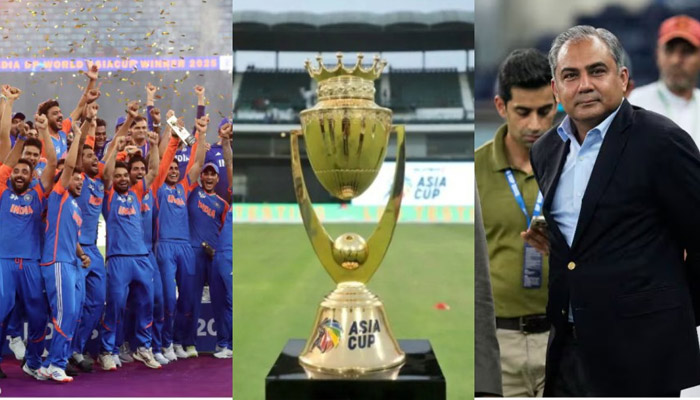
The Asia Cup trophy, ironically, never found its way home. What should have been a simple, proud moment of victory for India turned into a diplomatic and administrative standoff
A muddle of official silence, contradictory explanations and lingering resentment. The image of Indian players waiting for a presentation that never came has become symbolic of the strange space cricket now occupies between sport and politics.
And yet, barely weeks later, Indian cricket is already gearing up for another continental campaign — the Rising Star Asia Cup, featuring many of the same nations and familiar undercurrents. The speed and decisiveness of the BCCI’s preparation suggest not just professionalism, but intent: India will not be drawn into boycott or hesitation. It will play, and it will lead.
In the recently concluded Asia Cup, the Indian T20I side led by Suryakumar Yadav faced Pakistan three times in the space of ten days. What should have been a showcase of Asian cricketing excellence quickly turned into a series of flashpoints — on-field exchanges, symbolic gestures and heavy political undertones. The cricket itself became secondary. The controversy peaked when Asian Cricket Council (ACC) Chairman and PCB President Mohsin Naqvi declined to present the trophy to India after their victory — an act that was widely interpreted as a deliberate snub.
The International Cricket Council (ICC) later imposed fines and handed out demerit points to several players from both sides, citing “excessive celebration” and “provocative conduct.” But the larger issue — the unreturned trophy and the unresolved tension between the two boards — remains untouched. The hardware stays with the ACC, the bitterness stays with the players, and yet the cricket calendar rolls on.
Now, with the Rising Star Asia Cup set to begin in Doha on November 16, India and Pakistan are once again drawn into the same group. The draw could easily have separated them — but didn’t. The potential for another clash, possibly even a final, is no accident. For India, the question isn’t whether they can win again — it’s whether a victory would even be acknowledged in full measure this time.
Interestingly, India doesn’t need this tournament in developmental terms. Its domestic cricket structure — Ranji Trophy, Syed Mushtaq Ali, Vijay Hazare, and the IPL — already forms the deepest and most competitive system in Asia. India A tours across South Africa, England and Australia provide ample exposure for emerging players. From a purely cricketing standpoint, the Rising Star Asia Cup adds little that India doesn’t already have.
But the decision to participate carries a different kind of weight — one of presence and principle. India’s involvement ensures viewership, legitimacy and financial gravity for the event. Without India, the tournament is just another regional exercise; with India, it becomes a global fixture that draws attention, sponsors and audience interest.
There’s also a larger strategic layer: India’s growing assertion as a sporting power. With ambitions of hosting multi-nation events — and perhaps even the Olympics in the near future — India is consciously reinforcing its image as a consistent, reliable player in international sports governance. Backing out of tournaments, even for valid reasons, risks being read as retreat. Staying in, and performing on its own terms, signals authority.
So, as the Rising Star Asia Cup approaches, India steps onto the field again — not just to develop players, but to underline its stature. The squads may be labelled “A teams,” but the emotions will be anything but secondary. The anthems will sound the same.
Comments are closed.