
Parliament Passes ‘G Ram G’ Bill to Replace MGNREGA; Opposition Holds Overnight Protest

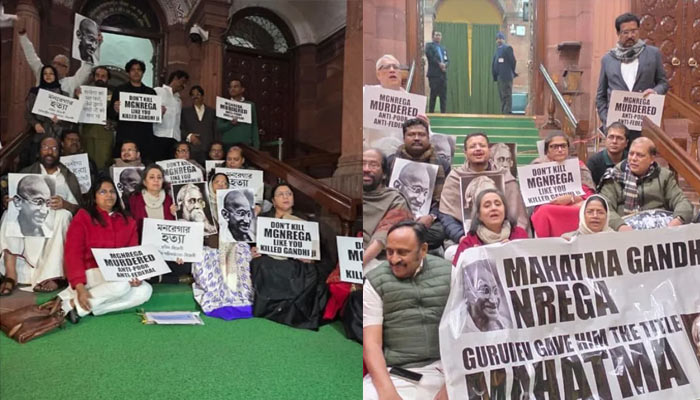
‘G RAM G’ Bill Replaces MGNREGA Amid Heated Parliamentary Debate, Opposition Protests Overnight.
The Viksit Bharat Guarantee for Employment and Livelihood Mission (Rural) Bill, popularly called the G RAM G Bill, meant to replace the UPA-era MGNREGA (Mahatma Gandhi National Rural Employment Guarantee Act), was passed by Parliament within two days amid intense protests and disruptions.
The Lok Sabha approved the bill on Thursday afternoon despite walkouts and opposition sloganeering, while the Rajya Sabha saw debates continue past midnight. The bill was ultimately cleared by voice vote around 12:15 am. Following the vote, MPs from the Trinamool Congress and other opposition parties staged a dharna inside Parliament, highlighting their strong objections to the law.
Opposition Raises Strong Objections
Congress chief Mallikarjun Kharge attacked the bill sharply, claiming it would harm the rural poor and urging the government to withdraw it. “You keep saying ‘Ram Ram’ for the poor, but you have a dagger hidden behind your back,” he said, emphasizing the change in name from Mahatma Gandhi to G Ram G. He pleaded, “Think again… There is still time to withdraw the law,” appealing to the government to reconsider.
Trinamool Congress MP Derek O’Brien highlighted the impact on state-run schemes, citing how West Bengal’s Karmashree programme had been renamed the Mahatmashree Scheme in response to the central law.
Union Minister Shivraj Singh Chouhan, who piloted the bill, defended the new legislation, accusing the Opposition of “betraying Bapu’s ideals” by walking out during his response. Chouhan argued that MGNREGA was historically a tool of corruption and that the updated bill incorporates modern reforms while reflecting Mahatma Gandhi’s social ideals.
Key Changes in the ‘G RAM G’ Bill
Work Guarantee: MGNREGA’s 100-day work guarantee has been raised to 125 days.
Work Allocation: Employment will now be generated through pre-approved plans, unlike the previous system where villagers could request work directly from gram panchayats. Critics argue this limits worker choice.
Four Focus Areas: The new law focuses on water security, core rural infrastructure, livelihood assets, and climate resilience, whereas earlier the work was decided by local needs.
Opposition Concerns
Critics contend that the new bill:
Removes the guarantee and security promised under MGNREGA.
Curbs flexibility by tying work to pre-approved plans rather than local demand.
Symbolically erases Mahatma Gandhi’s name from India’s flagship rural employment programme, replacing it with a reference to Lord Ram.
While the government maintains that the bill modernizes and strengthens the programme for rural development, the Opposition has warned of political and social repercussions, calling it a dilution of the spirit of MGNREGA.
The G RAM G Bill is now set to become the new framework for rural employment and livelihood schemes across India, marking a historic shift in the country’s social welfare policy.
Comments are closed.