
Earth’s Shifting Surface Plays Larger Role in Climate Change Than Thought

Earth has undergone dramatic climate shifts over hundreds of millions of years, swinging between freezing “icehouse” periods and warmer “greenhouse” states.
While scientists have long linked these changes to fluctuations in atmospheric carbon dioxide, new research suggests the sources of that carbon — and the forces driving it — are far more complex than previously understood.
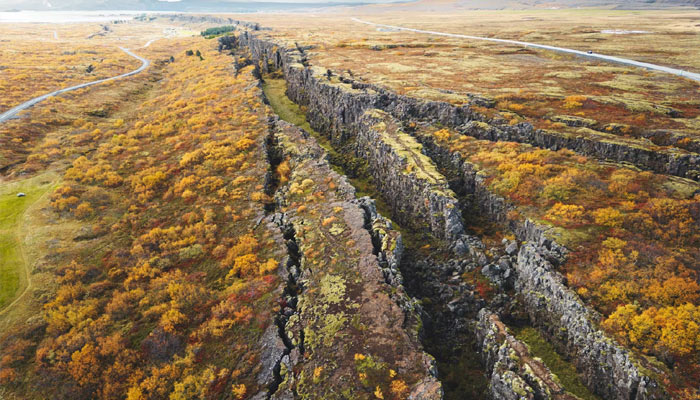
The movement of Earth’s tectonic plates, researchers say, plays a much larger and previously underappreciated role in regulating the planet’s climate. Carbon is not only released where tectonic plates collide, but also where they pull apart.
Peering into the deep carbon cycle
At convergent plate boundaries, chains of volcanoes known as volcanic arcs form. Melting associated with these volcanoes releases carbon that has been locked inside rocks for thousands of years, sending carbon dioxide back into the atmosphere. Traditionally, volcanic arcs were thought to be the dominant source of tectonic carbon emissions.
However, the new study challenges this view, arguing that mid-ocean ridges and continental rifts — regions where tectonic plates spread apart — have played a far greater role in Earth’s carbon cycle over geological time.
The world’s oceans absorb vast quantities of atmospheric carbon dioxide, storing much of it in carbon-rich rocks on the seafloor. Over thousands of years, this process can generate sediment layers hundreds of metres thick.
As tectonic plates move, these carbon-rich sediments are transported across the planet. When they eventually reach subduction zones — where one plate sinks beneath another — their stored carbon is released back into Earth’s interior and atmosphere. This circulation of carbon between Earth’s interior, oceans and atmosphere is known as the “deep carbon cycle”.
Using computer models to reconstruct tectonic plate movements over the past 540 million years, researchers tracked how carbon was stored and released throughout Earth’s history.
What the models reveal
The models successfully predicted major greenhouse and icehouse periods across geological time. During warmer greenhouse phases, more carbon was released into the atmosphere than was locked away in sediments. During colder icehouse periods, carbon sequestration in ocean sediments dominated, lowering atmospheric carbon dioxide levels and driving global cooling.
A key finding of the study is the crucial role played by deep-sea sediments. As tectonic plates slowly migrate, they transport carbon-rich sediments that are eventually recycled into Earth’s mantle through subduction. This process, the researchers found, is a major determinant of whether Earth enters a greenhouse or icehouse state.
Rethinking volcanic arcs
Carbon emissions from volcanic arcs have long been considered one of the largest contributors to atmospheric carbon dioxide. The study shows this only became true relatively recently — over the past 120 million years — due to the evolution of planktic calcifiers.
These microscopic marine organisms convert dissolved carbon into calcite, creating vast deposits of carbon-rich sediment on the ocean floor. Planktic calcifiers evolved around 200 million years ago and spread widely about 150 million years ago, dramatically increasing the amount of carbon recycled through subduction zones and released by volcanic arcs.
Before their rise, emissions from mid-ocean ridges and continental rifts were the dominant tectonic sources of atmospheric carbon dioxide.
A new perspective on climate
The findings offer a new framework for understanding how Earth’s climate has been shaped by deep geological processes. Rather than being driven solely by atmospheric dynamics, climate is influenced by a delicate balance between carbon released from Earth’s surface and carbon locked away in seafloor sediments.
The study also has implications for future climate modelling, particularly as human-driven carbon emissions push atmospheric levels higher.
Understanding how Earth’s natural carbon cycle — governed in part by the slow movement of tectonic plates — has regulated climate in the past can help scientists better anticipate future climate change and assess the long-term consequences of human activity.
Comments are closed.