
‘Retreat or Regret’: Iran Warns US After Strikes on Missile and Drone Sites

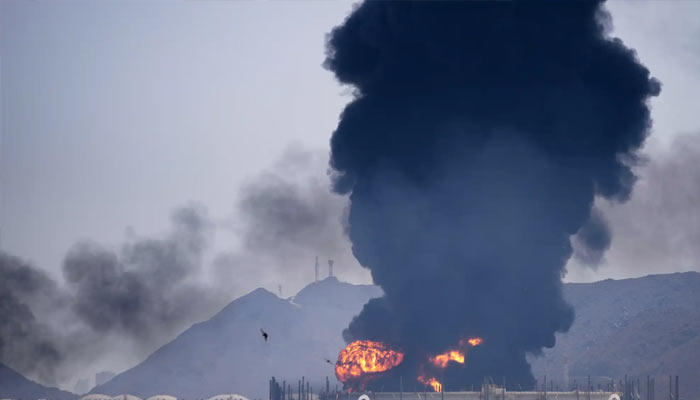
A fresh military confrontation between the United States and Iran unfolded on Friday.
After Washington carried out airstrikes on Iranian missile and drone facilities, accusing Tehran of violating a recent ceasefire understanding by attacking a commercial cargo ship in the Strait of Hormuz.
The strikes marked the first direct US military action since the two countries reached a fragile memorandum of understanding in Switzerland earlier this month.
Soon after the US operation, Iran’s Islamic Revolutionary Guard Corps (IRGC) announced retaliatory strikes on American military positions in the region, saying Washington’s actions would not go unanswered. Reuters reported that the IRGC had warned of a “decisive response” before launching the attacks. The extent of the damage and the locations targeted were not immediately disclosed.
Trump hinted at retaliation
Hours before the strikes, US President Donald Trump signalled that military action was imminent.
Asked whether the US would retaliate against Iran, Trump replied: “You’ll find out.”
Minutes later, US Central Command (CENTCOM) confirmed that American forces had conducted precision strikes on Iranian missile storage sites, drone facilities and coastal radar installations.
According to CENTCOM, the operation was launched in response to an alleged Iranian drone attack on the Singapore-flagged cargo vessel M/V Ever Lovely on June 25. The ship was sailing off the Omani coast after exiting the Strait of Hormuz when it was reportedly struck by a one-way attack drone.
US accuses Iran of violating ceasefire
CENTCOM described the operation as “a powerful response” to what it called an unprovoked attack on commercial shipping.
“The unwarranted aggression against commercial shipping by Iranian forces clearly violated the ceasefire,” the command said in a statement.
It also accused Tehran of threatening freedom of navigation through one of the world’s busiest maritime trade routes and said US forces would continue ensuring the safe passage of commercial vessels through the Strait of Hormuz.
US Vice President JD Vance echoed that message in a post on X.
“Iran signed a ceasefire agreement. We have honored it. If they have disagreements about how the MOU is being applied, they can pick up the phone. But violence will be met with violence,” Vance wrote.
Iran warns US of ‘retreat and regret’
Tehran strongly condemned the US strikes, accusing Washington of acting in bad faith while diplomatic efforts were still underway.
Iranian Deputy Foreign Minister Kazem Gharibabadi criticised a joint statement by the US and six Gulf states opposing Iran’s proposal to impose transit fees on ships passing through the Strait of Hormuz, calling it “interventionist, irresponsible and provocative.”
“Safe passage through the Strait of Hormuz cannot be guaranteed under ambiguous arrangements or arrangements that ignore Iran’s role as a coastal state,” Gharibabadi said.
Meanwhile, Ebrahim Azizi, head of the Iranian Parliament’s National Security Commission, accused the US of attacking Iran during negotiations and warned that Washington’s actions would end in “retreat and regret.”
The remarks came as Iran renewed its insistence that the strategic waterway should remain under regional oversight and rejected external efforts to shape its future.
Strait of Hormuz back in focus
The latest escalation has once again drawn global attention to the Strait of Hormuz, a vital shipping lane through which nearly one-fifth of the world’s oil and liquefied natural gas supplies pass.
Bloomberg reported that Oman has informed allies that vessels transiting the strait could eventually face transit fees, although no formal mechanism has been announced.
Iranian state television also reported that the IRGC had warned off three foreign oil tankers attempting what it described as an “unauthorised passage” through the waterway, though no further details were provided.
Despite the sharp rise in US-Iran tensions, diplomacy made progress elsewhere in the region. Israel and Lebanon signed a US-brokered framework agreement aimed at ending hostilities along their border. The proposal includes the eventual disarmament of Hezbollah and a phased Israeli withdrawal from parts of southern Lebanon, though Hezbollah has rejected the agreement and said it will not cooperate.
Comments are closed.