

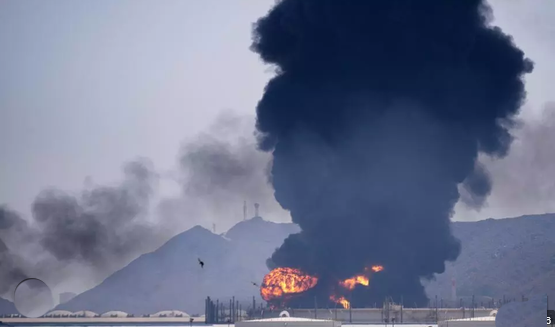
Bahrain and Kuwait came under incoming Iranian missile fire early Friday as the United States widened its military campaign against Iran, launching new airstrikes that targeted bridges and other strategic sites.
The two Gulf nations, both of which host US military forces, have faced repeated Iranian attacks in recent days after an interim ceasefire collapsed amid renewed fighting over the Strait of Hormuz.
Iran’s state-run IRNA news agency reported that at least three people were killed in US airstrikes on bridges in the southern province of Hormozgan. On Thursday, US forces expanded their operations by striking targets farther north and firing on a ship Washington accused of attempting to breach its naval blockade of Iran. Tehran responded with missile and drone attacks targeting US allies across the region.
The latest escalation follows the breakdown of a temporary truce reached last month. Since then, the US and Iran have exchanged daily attacks as they battle for control of the Strait of Hormuz. Iranian officials say more than 35 people have been killed and over 300 injured in US strikes.
For the first time during the current conflict, American attacks also reached areas near Tehran, signaling an expansion of US military targets. A second wave of strikes late Thursday was aimed at further weakening Iran’s military capabilities, according to US officials.
The conflict began on February 28 when the US and Israel launched military operations against Iran. Tehran subsequently closed the Strait of Hormuz to commercial shipping, triggering a sharp rise in global oil prices and increasing its leverage in diplomatic negotiations.
Col. Ebrahim Zolfaghari, spokesperson for Iran’s Khatam Al-Anbiya Central Headquarters, warned that Tehran could target infrastructure across the region if the US follows through on President Donald Trump’s warnings of strikes against Iranian bridges and power facilities. He said Iran would not allow foreign interference in the Strait of Hormuz, describing it as the country’s “invincible red line.”
Qatar reports missile interception
Qatar’s Defence Ministry said its armed forces intercepted a missile attack early Friday, while the Interior Ministry later announced that the security threat had ended. Residents in Doha reported hearing several explosions after emergency alerts were sent to mobile phones. Officials did not identify who launched the attack.
US and Iran exchange fresh attacks
Iranian state media reported that US strikes hit locations around Tehran and Semnan province, home to Iran’s ballistic missile production and space programme. Additional strikes were reported in Hamedan, Hormozgan, Khuzestan, Lorestan, Markazi, Sistan and Baluchestan, as well as on Qeshm Island near the Strait of Hormuz.
In Bandar Abbas, seven people were reported wounded after a strike on the Allah-Akbar Hill residential area, while two others were injured in an attack on the city’s railway junction. West of Bandar Abbas, US strikes on two bridges reportedly killed three people and wounded nine others.
US Central Command also said it struck Iranian defence and missile facilities on Greater Tunb Island, one of three disputed islands that give Iran strategic control over the entrance to the Strait of Hormuz.
The US military further said it disabled a Curacao-flagged oil tanker heading toward Iran’s main oil export terminal after the vessel allegedly ignored repeated warnings.
Earlier this week, another US strike targeted a barracks belonging to Iran’s 388th Mechanized Infantry Brigade in Sistan and Baluchestan province. Iranian state television said seven soldiers, including conscripts and career personnel, were killed.
Iran responded on Thursday by launching missiles and drones toward Bahrain, Jordan and Kuwait, according to authorities in those countries. No immediate reports of casualties or significant damage were released.
In Iraq, Prime Minister Ali Al-Zaidi condemned an overnight drone attack in the Kurdistan region after authorities said the drone had been intercepted. A separate drone also targeted an oil tanker in the Arabian Gulf off the coast of Basra, though no injuries were reported.
Trump says diplomacy remains possible
The fighting has increasingly centred on the Strait of Hormuz, where Iran has targeted vessels using a US-controlled shipping route.
According to maritime data firm Lloyd’s List Intelligence, weekly cargo traffic through the strait had already fallen by nearly a quarter before the latest escalation. Some shipping companies have switched off vessel tracking systems while others have suspended voyages altogether. Although more oil is now being transported through regional pipelines, analysts say they cannot fully compensate for reduced maritime shipments.
US Central Command said it had redirected three commercial vessels attempting to enter the blockade zone, disabled one that failed to comply with warnings and boarded another to ensure compliance.
Despite the escalating conflict, President Donald Trump said he still believes a negotiated settlement with Iran is possible.
“They don’t like what we’re doing, and they do want to settle. We’ll find out whether or not we settle with them, or we just finish it off,” Trump said during a visit to the US Army War College on Wednesday.
Pakistan’s Foreign Ministry said diplomatic efforts to bring Washington and Tehran back to negotiations were continuing, although officials acknowledged the task had become increasingly difficult.
Trump also said Iran had released an American citizen detained since 2024 as a goodwill gesture. Human rights lawyer Jared Genser identified the individual as Dena Karari, a US-Iranian citizen and nonprofit director who had faced espionage charges. Iranian authorities did not immediately confirm her release, and her detention had not previously been made public.
Comments are closed.