
France’s Badminton Revolution: How the Country Produced World Champions

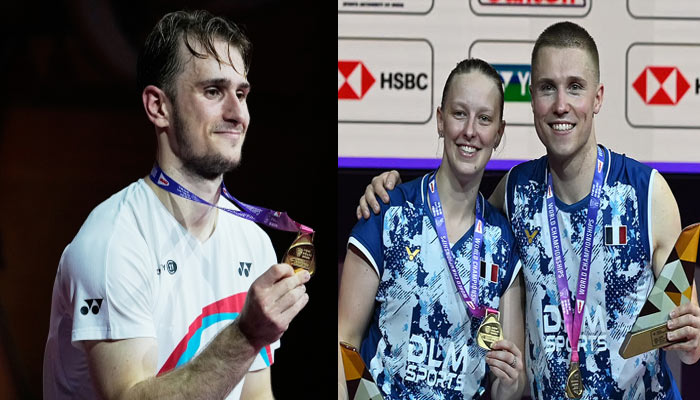
France’s emergence as a force in badminton was decades in the making, but two historic World Championships titles in New Delhi have given the country’s growing ambitions a major boost.
Alex Lanier became the first Frenchman to win the men’s singles title at the BWF World Championships, hours after Thom Gicquel and Delphine Delrue secured France’s first world title in mixed doubles.
The two victories marked an extraordinary day for French badminton and even drew a congratulatory message from President Emmanuel Macron. Yet the celebrations also highlighted how far the sport still has to go in France, where football, rugby, cycling and other Olympic disciplines traditionally dominate the sporting conversation.
A SYSTEM BUILT OVER DECADES
France’s success did not appear overnight. According to French federation technical director Cyrille Gombrowicz, the foundation was laid in 1980, when the country established its first national performance centre.
What began largely as a club-based sport gradually developed into a structured national pathway. Two additional centres for young players were created, followed by nine regional centres. The federation now works with around 60 clubs and has built a large pool of coaches involved in elite development.
The current generation is the result of that long-term approach. Lanier and brothers Christo and Toma Junior Popov have helped France establish a strong presence in men’s singles, while Gicquel and Delrue have become one of the country’s leading doubles partnerships.
“The system started the job 20 years ago, and now the fruits are coming,” said Lanier’s coach Kestutis Navickas.
Lanier’s own development illustrates the pathway. He was identified as a promising youngster, trained at a club in Normandy, moved to a regional centre in Caen and eventually joined France’s national centre at INSEP.
His progress has involved much more than improving his badminton skills. Coaches have worked on his technique, tactics, fitness, recovery, diet and mental approach, gradually turning potential into elite performance.
SCIENCE BEHIND THE SUCCESS
France has also placed increasing emphasis on sports science and data.
The federation works with performance director Thierry Soler to analyse training loads, match demands, competition schedules and individual preparation. The objective is not to let data replace coaching, but to combine statistics with experience and judgement.
That approach has influenced Lanier’s physical preparation. His gym workload was recently reduced, not to diminish his strength but to help him become faster and maintain his level across demanding tournaments.
French players also used tracking devices during the World Championships in Delhi, allowing the team to monitor movement and physical demands.
Gicquel believes the value of sports science lies in long-term planning rather than producing an immediate advantage.
“It’s helping to plan and to be smart during the year,” he said.
FROM PARTNERSHIP TO WORLD CHAMPIONS
Gicquel and Delrue provide another example of France’s patient development model.
The pair began playing together at around 17 after entering the national system. Initially, their relationship was far from smooth. Gicquel said they barely spoke during their first few years together.
With help from coaches and mental-performance specialists, they gradually learned to communicate and developed a shared style based on speed and attacking badminton.
A bronze medal at the 2025 World Championships in Paris became an important milestone. It was the first World Championships medal produced by France’s own development system, following Pi Hongyan’s bronze in 2009 after she had arrived from China as an established player.
A year later, Gicquel and Delrue have gone one better.
Their progress also changed their belief in what was possible. Early victories, including a Super 100 title and a win over a top-five pair, gradually convinced them that they could compete with the sport’s established powers.
DEPTH GIVES FRANCE A CHANCE
The men’s singles results tell a similar story.
Christo Popov has established himself among the world’s top players and won the World Tour Finals last year and the Japan Open this year. His younger brother Toma Junior has also become a major presence, while Lanier has now joined them at the highest level.
That depth has already produced a historic Thomas Cup campaign. France reached the final of the world men’s team championship for the first time, defeating India 3-0 in the semi-final. Christo Popov beat Ayush Shetty, Lanier defeated Kidambi Srikanth and Toma Junior Popov overcame HS Prannoy.
France eventually lost the final 3-1 to China, but the silver medal was the country’s first-ever Thomas Cup medal.
The success has created a sense of collective belief within the team. After Gicquel and Delrue won their world title in Delhi, Lanier said he felt motivated to complete a remarkable day for the French contingent.
The players were also backed by a sizeable performance team, including coaches, strength and conditioning specialists and technical staff. Their success reflects a broader support structure rather than the efforts of individual athletes alone.
A LARGE GRASSROOTS BASE
France’s badminton infrastructure is supported by a substantial playing community. The country has around 250,000 licensed badminton members, providing a significant talent pool even though the sport does not command the same attention as football or rugby.
Lanier’s journey shows how that pool can feed into an elite pathway: club badminton, regional training, a national centre and eventually an international high-performance environment.
The model combines federation resources, government support, coaching development and sports science to create opportunities for talented players to progress.
MORE TO ACHIEVE
Despite the historic success in Delhi, French officials are not claiming that the country has become a badminton powerhouse.
Gombrowicz acknowledges that France remains competitive in only a limited number of events. Countries such as China, Japan, South Korea, Indonesia and Malaysia still possess far greater depth across the disciplines.
France’s next target is therefore to increase the number of players inside the world’s top 30 and become competitive across more events.
The two world titles are less an endpoint than evidence that the system is working.
More than four decades after France began building its elite badminton structure, players from the country are finally standing at the top of the world podium. The challenge now is to turn that breakthrough into sustained success.
Lanier’s own philosophy remains simple. He says badminton should first be something people enjoy and share with others.
For France, that simple game has gradually become something much bigger. What began in clubs has evolved into a national performance system capable of producing world champions.
The rest of the badminton world is now paying attention.
Comments are closed.