
Mirka Federer’s Emotional Hall of Fame Speech Leaves Roger Federer Laughing and in Tears

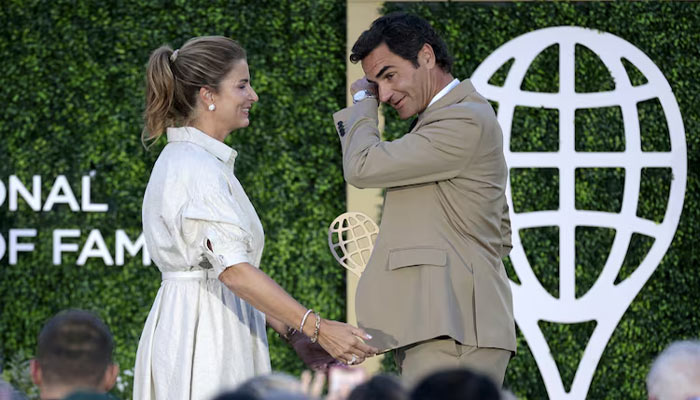
For years, Roger Federer made tennis look almost impossibly easy. On the night he entered the International Tennis Hall of Fame in Newport, however, it was his wife Mirka who left the Swiss legend struggling to find the right words.
After Mirka introduced Federer with an emotional speech, the newly inducted Hall of Famer walked toward her, embraced her and kissed her. He wiped away tears before attempting to regain his composure.
Then came a joke that immediately lightened the moment.
“She is a good public speaker. I didn’t know that,” Federer said with a smile.
Federer, 45, admitted that he had not heard his wife deliver a public speech in decades. The last time, he recalled, was at the Hopman Cup, where they played mixed doubles together 24 years ago.
“So this is very well done,” he said. “I don’t know if you had been secretly practising. But this is a very high level and a tough act to follow.”
Mirka’s speech had been anything but a conventional tribute to one of tennis’ greatest champions. Rather than focusing on Federer’s 20 Grand Slam titles, 103 ATP trophies or 310 weeks at No. 1, she spoke about the person behind the remarkable statistics.
WHERE THEIR STORY BEGAN
Mirka took the audience back to the Sydney Olympics in 2000, where she and Federer first met. Federer was 18 at the time, while Mirka was 21.
“Yes, I was the older woman,” she joked, recalling how Federer pursued her despite the age difference.
When they met, Federer was still searching for his first ATP title.
“When we met, he had exactly zero ATP titles. Zero,” she said. “Looking back, I suppose I was there for all 103 that followed.”
Mirka was more than a spectator throughout Federer’s rise. A former professional tennis player herself, she was sometimes involved in his preparation and even warmed him up before matches.
That led to a memorable joke from Andy Roddick after losing to Federer in the Cincinnati final.
“I can’t believe I lost to a guy whose girlfriend warmed him up,” Roddick joked.
Mirka said the line remains a favourite memory for the couple.
But her tribute soon moved beyond tennis.
She described Federer as someone who always wanted the people closest to him nearby and said that quality was among the things she admired most about him.
She also knew better than most that Federer’s effortless appearance on court concealed years of sacrifice.
“I saw the work, the hours, the discipline, the commitment,” she said, explaining that she witnessed everything required to make his performances appear so effortless.
Yet, according to Mirka, his greatest quality had nothing to do with his achievements on a tennis court.
“The man behind it all is even more remarkable,” she said.
FAMILY BEFORE TENNIS
One of the most emotional parts of Mirka’s speech came when she spoke about Federer as a father.
She remembered learning that the couple were expecting twins and worrying about how they could continue travelling around the world with two babies.
Mirka told Federer that she might have to stop travelling with him.
His response was immediate.
“Then I won’t play anymore.”
According to Mirka, Federer was completely serious. His family, she said, always came first.
The family eventually found a way to remain together on tour. Strollers, toys, books and children became part of their travelling lives. Years later, they welcomed another set of twins.
Their four children — Myla, Charlene, Leo and Lenny — experienced Federer not as the celebrated “Swiss Maestro”, but simply as their father.
He was the dad who read bedtime stories, played games, ran baths and made them laugh, Mirka said. Whether he had won or lost a match, he always found time for his children.
She also paid tribute to Federer’s parents, Robert and Lynette, saying they had instilled humility, gratitude and kindness in their son.
For Mirka, those qualities represented Federer’s most important legacy.
“The trophies and records are extraordinary. But they are only part of his legacy,” she said. “What makes me proudest isn’t what Roger accomplished when the world was watching. It’s who he is when nobody’s watching.”
By the conclusion of her speech, Federer was visibly emotional.
Mirka told him that watching his career had been one of the greatest privileges of her life, but that sharing his life had meant even more.
She then introduced him not as a sporting icon, but as the person closest to her:
“My husband, my best friend, and now the newest member of the International Tennis Hall of Fame.”
FEDERER STRUGGLES TO HOLD BACK TEARS
When Federer eventually took the microphone, he became emotional several times while thanking the people who had influenced his journey, including childhood idol Stefan Edberg and longtime coach Severin Lüthi.
But speaking about Mirka proved particularly difficult.
“Now the Mirka part,” he said before pausing.
“Oh gosh, this is such a mess.”
He joked that he needed “tissues and sunglasses” before continuing.
Federer described Mirka as far more than his wife. She had also been his coach, hitting partner, reality check and even his stylist.
“I definitely needed one at that time,” he joked.
He then turned serious.
Federer said Mirka had helped him become more focused on tennis while also teaching him to enjoy everything outside the sport.
He praised her as “a wonderful mother to our four kids” and described their partnership in characteristically simple terms.
“She and I grab each other’s hands, and we run through walls.”
The emotion of the evening was striking precisely because Federer had spent much of his career being synonymous with composure. On court, he was celebrated for his control and precision. In Newport, those qualities disappeared when he spoke about the woman who had shared his journey.
MORE THAN THE NUMBERS
Despite being the centre of an event celebrating his extraordinary career, Federer spent surprisingly little time talking about himself.
He reflected instead on tennis, his childhood in Basel, his memories as a ball boy and the players he once admired from a distance.
He thanked his family, coaches, rivals, friends and fans before reflecting on a career that produced 20 Grand Slam titles, 103 ATP titles and 310 weeks at No. 1.
But those numbers seemed less important than the relationships and memories created along the way.
“This is one of the greatest honours of my life,” Federer said. “They call this the Hall of Fame, but fame was never the goal.”
For Federer, the real reward was spending decades doing something he loved alongside people who shared that passion.
“Tennis meant the world to me,” he said. “Not just playing, not just winning, but creating something new.”
He described his playing career as a continuing “love letter to tennis”, making clear that retirement had not ended his relationship with the sport.
“My family, our friendships, the past 40 years, the future we’re building, tennis, for me, is responsible for it all,” he said.
“So this is not a goodbye.”
And perhaps that was the most fitting conclusion.
Federer spent a quarter of a century captivating millions with a racket in his hand. In Newport, though, the most revealing portrait of the champion came from the person who had stood beside him throughout that journey.
For one night, the spotlight belonged not to the 20-time Grand Slam champion, but to Mirka Federer — the wife, friend, partner and lifelong companion who reminded the world that behind the records was simply a man who valued his family above everything else.
Comments are closed.