
Congress, CJP Clash Over Credit as Youth Protests Trigger Opposition Turf War

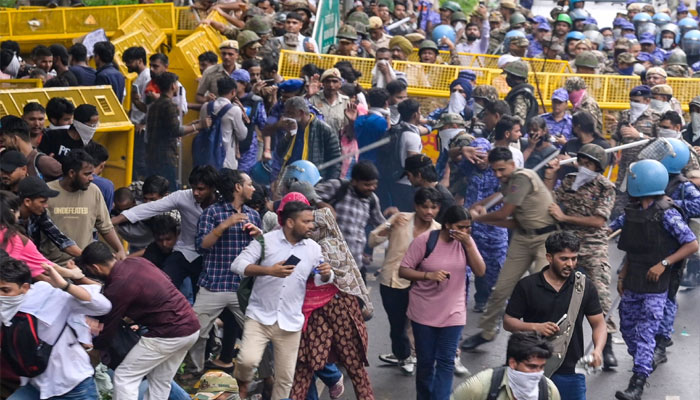
A growing political tussle over the credit for recent youth protests has brought the Congress and the student-led Cockroach Janta Party (CJP) into an increasingly visible online confrontation.
What began as a satirical digital movement associated with Gen Z has evolved into a street-level campaign, with CJP activists mobilising young protesters at Jantar Mantar. The movement’s growing visibility has now triggered a debate over who should get credit for the political and legal developments surrounding the protests.
The latest dispute followed judicial developments involving cases against student demonstrators. After the Supreme Court quashed police proceedings against protesters, Congress supporters on social media circulated posts linking the relief to Rahul Gandhi’s political and legal efforts.
CJP activists rejected that narrative, arguing that the student movement was built independently and that young protesters faced police action on the ground. They shared screenshots on social media alleging that Congress was attempting to associate itself with a movement it did not create.
FROM ONLINE SATIRE TO STREET PROTESTS
The CJP initially emerged as an online satire platform, using humour and political parody to highlight issues such as youth unemployment and political disengagement. Its campaign subsequently moved beyond social media, with activists organising large gatherings at Jantar Mantar.
The mobilisation has given the group a visibility that traditional political organisations have struggled to ignore.
At the heart of the current dispute is a larger question over political ownership. Congress has sought to position itself as a broad platform for opposition to the government, while CJP supporters argue that independent youth movements should not be absorbed into the organisational framework of established parties.
The disagreement has increasingly played out online, where supporters of both sides have attempted to shape the narrative around recent protests and court-related developments.
SWATANTRA BHARDWAJ CASE ADDS TO TENSIONS
The differences also became visible during the controversy surrounding self-styled Hindutva influencer Swatantra Bhardwaj.
Bhardwaj was arrested on Saturday following allegations that he assaulted Sanjay Kumar, the father of student activist Nishu Azad, during a CJP rally.
Both Congress and CJP members condemned the alleged assault and questioned the initial police response. However, their cooperation soon gave way to disagreements over how the issue should be pursued.
CJP activists and independent representatives organised demonstrations outside the Parliament Street police station, pressing for action and broader legal reforms. Some CJP leaders also criticised attempts to present the subsequent legal developments as the achievement of a particular political party.
OPPOSITION FACES A NEW POLITICAL CHALLENGE
The dispute reflects a broader challenge for established opposition parties as decentralised, social-media-driven youth movements become increasingly influential.
Unlike conventional political organisations, platforms such as CJP can mobilise supporters without a formal party structure, established leadership or traditional electoral machinery. Their reliance on memes, viral content and direct street mobilisation allows them to build momentum rapidly.
For Congress, the emergence of such movements presents an opportunity to connect with younger voters and expand its opposition campaign. For CJP activists, maintaining independence from established parties is central to the movement’s identity.
The growing credit battle therefore goes beyond competing social-media posts. It highlights a deeper struggle over who represents India’s politically active youth—and whether emerging grassroots movements will remain independent or eventually become part of the established opposition ecosystem.
Comments are closed.