

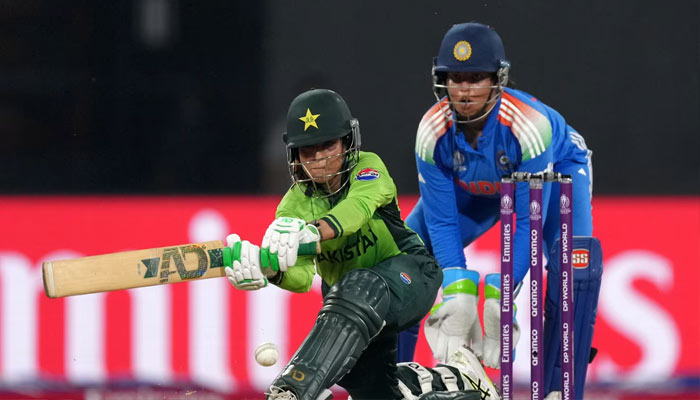
India entered their Women’s Asia Cup clash against Pakistan as overwhelming favourites, and they delivered a performance that reflected the gulf between the two sides.
At the Dubai International Cricket Stadium on Saturday, India cruised to a seven-wicket victory after once again using their spin attack to dismantle Pakistan’s batting.
The pattern was familiar from their Women’s T20 World Cup meeting earlier this year, but Pakistan’s collapse was even more dramatic this time. After reaching 27/0, they lost their final 10 wickets for just 28 runs to be bowled out for 55 — their lowest-ever total in Women’s T20Is.
India were not at their sharpest in the field, with several missed chances and misfields offering Pakistan opportunities to build a competitive total. But once the spinners came into the attack, Pakistan had no response. India’s varied pace, flight and trajectory repeatedly created pressure, leaving the Pakistani batters unable to form partnerships or score freely.
The victory was particularly significant for Harmanpreet Kaur, who marked her 150th T20I as captain with a comfortable win. Pakistan, on the other hand, endured a forgettable 200th Women’s T20I. The result also extended India’s dominant record against Pakistan in the Women’s Asia Cup to 7-1.
PAKISTAN MAKE A BRIGHT START
Pakistan began positively, with Muneeba Ali and Shawaal Zulfiqar putting together a confident opening partnership. They negotiated India’s early bowling and gradually began finding scoring opportunities.
Kranti Gaud opened with a wide before settling down, beating Muneeba with an excellent wobble-seam delivery. India’s fielding, however, let them down early. A misfield in the covers gave Pakistan three runs, while Pratika Rawal dropped a straightforward chance from Muneeba. Another error at mid-off added to India’s frustration.
Nandani Sharma kept the openers under pressure with her round-arm action and sharp inswing, but Zulfiqar began to counterattack. She struck the first boundary by lifting Nandani over mid-on and found the fence again soon after.
Pakistan appeared to be building a useful platform. Then everything changed.
Shafali Verma provided the breakthrough, bowling Muneeba for 13 after the opener made too much room. The dismissal triggered a collapse Pakistan could not stop.
INDIA’S SPINNERS DESTROY PAKISTAN
Shree Charani was the catalyst for Pakistan’s spectacular slide. She used flight, dip and turn brilliantly, first deceiving Gull Feroza before trapping Zulfiqar lbw. Ayesha Zafar fell soon after when she failed to clear mid-on.
Prema Rawat then tightened the pressure with disciplined leg-spin. She initially spilled a difficult return chance from Fatima Sana but immediately made up for it by bowling Sadaf Shamas for three.
Deepti Sharma added another blow by trapping Pakistan captain Fatima Sana lbw without scoring. From 27/0, Pakistan were suddenly struggling to avoid an embarrassing total.
India’s spinners kept varying their pace and trajectory, making it increasingly difficult for Pakistan to rotate the strike. Boundaries became scarce, partnerships disappeared and wickets continued to tumble.
Eyman Fatima’s dismissal summed up Pakistan’s innings. After Deepti fumbled a throw, Fatima appeared to have survived, only for the Indian all-rounder to recover quickly and break the stumps for a run-out.
Rawat went on to remove Nashra Sandhu and Umm-e-Hani to finish with three wickets, while Charani also claimed three. Richa Ghosh and Deepti combined to complete the final dismissal, with Tuba Hassan stumped for nine.
Pakistan were all out for 55, leaving India with a target that was never likely to trouble them.
SHAFALI REACHES 3,000 T20I RUNS
India’s chase was expected to be straightforward, although Pakistan briefly threatened to make it interesting.
Shafali Verma immediately showed her intent, launching Sadia Iqbal over long-off for a six from the first ball. She then took a single to reach 3,000 Women’s T20I runs, becoming the youngest player to achieve the landmark at 22 years and 220 days.
Shafali became only the 16th player overall and the third Indian woman, after Smriti Mandhana and Harmanpreet Kaur, to join the 3,000-run club.
Her innings did not last much longer. Fatima Sana got the breakthrough when Shafali attempted to attack again but edged a ball that stopped slightly after pitching, sending it straight back towards the bowler. She was out for 12.
Pakistan struck again almost immediately. Pratika Rawal edged Fatima’s back-of-a-length delivery through to Muneeba for four, continuing a disappointing run after her failure against Hong Kong.
Fatima had removed both Indian openers, but India still needed only 27 more runs.
Mandhana attempted to relieve the pressure with a boundary against Sadia Iqbal, but Fatima struck once again, trapping her lbw for nine. India were suddenly 29/3, although Pakistan’s hopes remained slim given the tiny target.
HARMANPREET AND DEEPTI FINISH THE JOB
Harmanpreet Kaur and Deepti Sharma made sure there was no late twist. The experienced pair avoided unnecessary risks, rotated the strike and calmly chipped away at the remaining target.
Pakistan experimented with their field placements, but defending 55 left them with almost no margin for error. India, who had already secured a place in the semi-finals, had little reason to take risks.
Harmanpreet eventually ended the contest emphatically. After finding the boundary, she stepped out to launch the next delivery over the ropes and seal a seven-wicket victory.
India finished on 57/3 in just 8.4 overs, with Harmanpreet unbeaten on 18 and Deepti Sharma on 12.
The result further underlined India’s position among the tournament favourites. Pakistan, meanwhile, have little room left for error and now face a crucial clash against Hong Kong, where another defeat could end their campaign.
India will take plenty of confidence from another dominant result, although their dropped catches, misfields and brief top-order wobble will be areas they will want to address before the knockout stage.
Comments are closed.