
Nepal PM Balendra Shah Walks India-China Tightrope in UN Climate Address

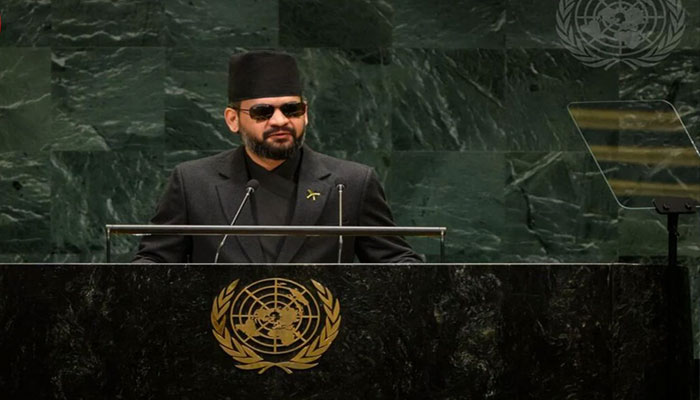
Nepal PM Balendra Shah Calls for India-China Climate Cooperation at UN
Nepal Prime Minister Balendra (Balen) Shah used his maiden address to the 81st UN General Assembly to propose a trilateral Himalayan Climate Resilience Mechanism involving Nepal, India and China, following the devastating floods that struck the Himalayan nation.
Shah called for the three countries to share satellite data, technical expertise and early-warning information to better monitor climate-related risks across the fragile Himalayan region.
Highlighting the wider significance of the Himalayas, Shah told world leaders that nearly two billion people depend on the Hindu Kush Himalaya for water, agriculture, ecosystems and livelihoods.
“The Himalayas are not peripheral to the planet. They are part of the planet’s life-support system,” Shah said.
He proposed that Nepal, India and China establish a mechanism to jointly monitor glacial lakes, strengthen early-warning systems and coordinate emergency assistance when disasters occur.
Balancing India and China
Shah’s proposal also reflects Nepal’s long-standing effort to maintain strategic space between its two powerful neighbours, India and China. Successive Nepali governments have sought to balance relations with both countries while protecting Kathmandu’s strategic autonomy.
“The Hindu Kush Himalaya is home to nearly two billion people,” Shah said, stressing that environmental risks in the region extend well beyond national borders.
He pointed to melting permafrost and destabilising mountain slopes as factors increasing the risks of ice-rock avalanches, floods and landslides.
According to Shah, the recent disaster demonstrated how interconnected these risks are, with the destruction beginning near the Nepal-China border before floodwaters moved downstream towards India.
“Climate change does not recognise borders. Glaciers and floods do not travel with a visa stamped on passports,” he said.
Praise for India’s and China’s Support
Shah also thanked India and China for providing assistance after the disaster, along with other countries, UN agencies, humanitarian organisations and people around the world.
“Our immediate neighbours, India and China, offered prompt and generous assistance,” he said.
The Nepalese prime minister said the country now faces a huge recovery and reconstruction challenge. The floods damaged roads, bridges, schools, homes, farmland, livelihoods and clean-energy infrastructure, adding pressure on an already resource-constrained economy.
Huge Reconstruction Bill
The flash floods followed an ice-rock avalanche near the Nepal-Tibet border on August 26, devastating communities across northern and central Nepal.
Official assessments put the death toll at 1,452, while thousands of people remain missing.
A Rapid Disaster Needs Assessment prepared jointly by Nepal’s National Planning Commission and the National Disaster Risk Reduction and Management Authority estimated the disaster caused around $2.69 billion in losses.
The assessment said Nepal would require approximately $4.77 billion for reconstruction and recovery, equivalent to about 10% of the country’s GDP.
Against this backdrop, Shah’s UN proposal seeks to turn the Himalayan region into a platform for cross-border climate monitoring and disaster cooperation, with Nepal, India and China sharing information and expertise before extreme weather events become humanitarian disasters.
Comments are closed.